Create Event Manga
Create amazing AI-powered event manga with dynamic panels and compelling storytelling
Create Your Event Manga in 3 Simple Steps
Describe Your Story
Tell us what you want to happen in your manga. Be creative with characters and plot!
Choose Your Style
Select a manga style and panel layout that matches your vision.
Generate & Download
AI creates your manga instantly. Download in high quality or share online!
- Start with a clear story concept
- Plan your panel layout carefully
- Focus on character expressions
- Use speech bubbles effectively
Story Ideas for Your Event Manga
Create an exciting event story
Use This IdeaDesign compelling characters and scenes
Use This IdeaBuild an immersive manga world
Use This IdeaTell your story with visual impact
Use This IdeaPopular Event Manga Genres
Action Adventure
Comedy
Drama
Mystery
Romance
Thriller
Powered by Advanced AI Manga Generation
Our AI understands manga storytelling, panel composition, and visual narrative. Each manga page is uniquely generated with consistent characters and authentic Japanese comic aesthetics.
Manga Understanding
AI comprehends manga flow and pacing
Panel Composition
Authentic manga layouts and framing
Consistent Style
Maintains character and art consistency
Recently Created Event Manga
Get inspired by manga from our community
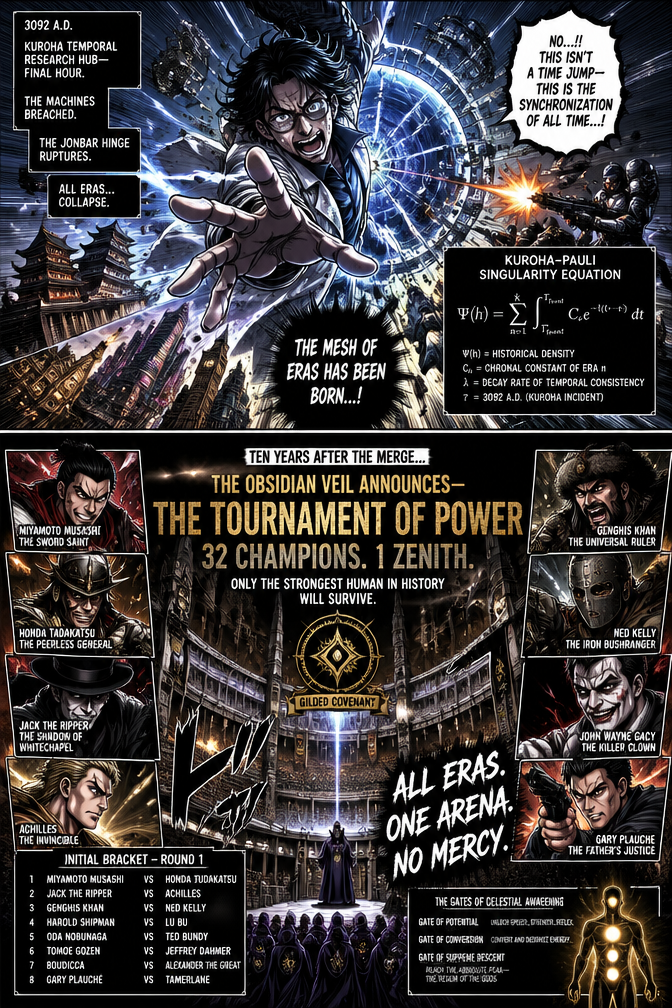
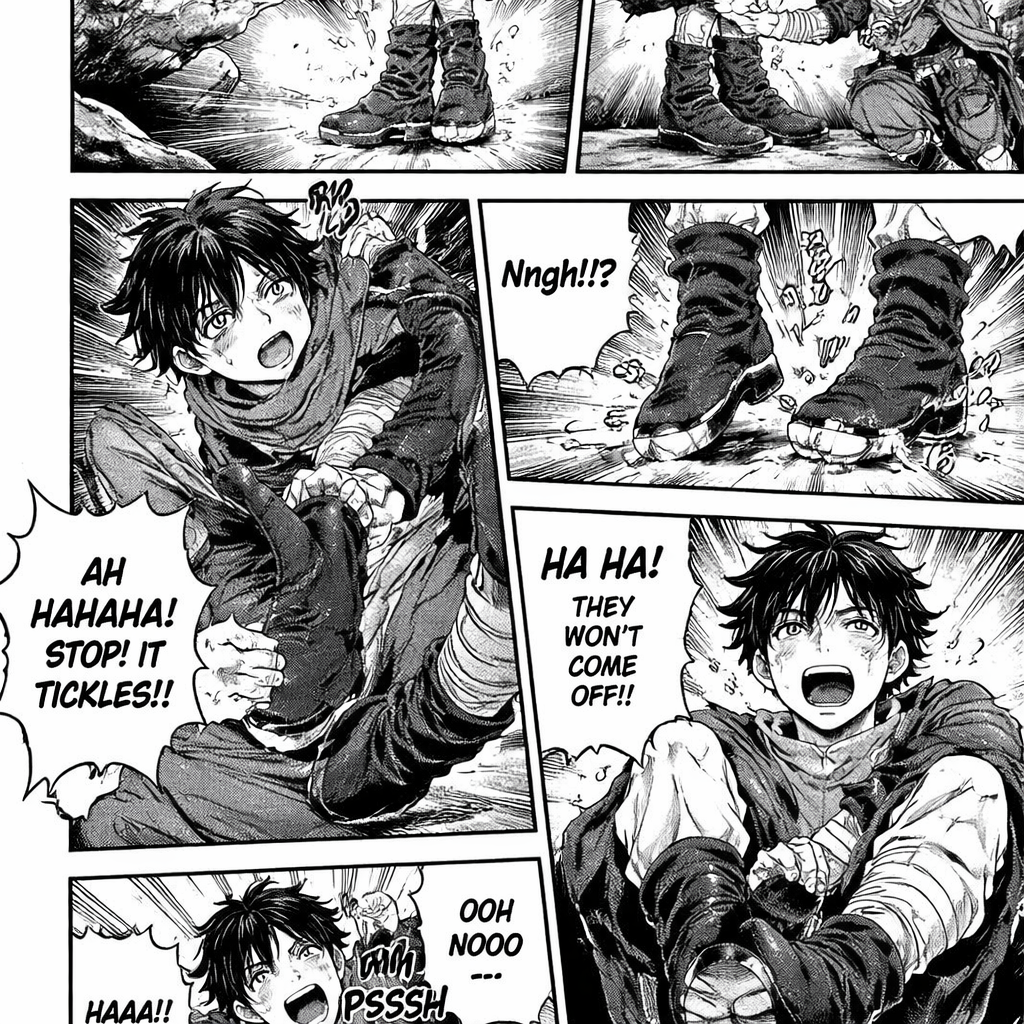
![# KINGDOM_SEQUEL_PRO_DIRECTIVE_v1
# Purpose: Copy/paste directive for a professional manga-generation AI.
# Output Target: Serialized manga chapters with panel scripts + dialogue + scene direction.
project:
title_working: "KINGDOM: AFTER THE UNIFICATION"
relationship_to_original: "Direct sequel (chronologically consistent continuation)"
medium: "Manga (black-and-white), weekly serialization pacing"
language:
script: "Japanese-style dialogue rhythms but written in English"
onomatopoeia: "Romanized SFX allowed (e.g., GOGOGO, DON, ZAA), minimal and purposeful"
audience: "Seinen/Shonen crossover (political-military epic; grounded realism with high drama)"
canon_constraints:
continuity:
- "Maintain political geography, factions, ranks, and court protocol consistent with Warring States → early Qin Empire transition."
- "No retcons that contradict established historical macro-events; micro-events may be dramatized within plausibility."
- "Do not mimic or quote any existing Kingdom lines verbatim; create original dialogue and scenes."
tone:
- "Strategic realism: logistics, intelligence, morale, propaganda, law, and governance are treated as causal mechanisms."
- "Heroic intensity is earned via constraints, costs, and tradeoffs—never by arbitrary power spikes."
thematic_core:
- "War-to-state transition: violence becomes administration; conquest becomes legitimacy maintenance."
- "Structure beats spectacle: outcomes are driven by supply lines, institutions, incentives, and narrative misdirection."
- "The true battlefield becomes governance: law, tax, land, bureaucracy, succession, and information control."
narrative_thesis:
logline: >
After unification, Qin discovers that conquering a continent is easier than governing it;
the new war is against entropy—rebellion, corruption, succession anxiety, and the friction
between idealized unity and lived provincial realities.
format_requirements:
deliverables_per_chapter:
- "Chapter title + 1-sentence hook"
- "Cold open: 2–4 pages that immediately establishes conflict and stakes"
- "Full panel script: page-by-page, panel-by-panel"
- "Dialogue + subtext notes (what is said vs. what is meant)"
- "Tactical layer: battlefield / administrative mechanics that explain why events unfold"
- "Cliffhanger: last 1–2 panels engineered to compel next chapter"
paneling_rules:
- "Average 17–21 pages per chapter"
- "Large establishing panel at least once every 2–3 pages"
- "At least one silent panel sequence per chapter to externalize cognition (faces, hands, maps, ledgers, roads)"
- "Action clarity: emphasize readable spatial logic; avoid incoherent motion"
style_guidelines_visual:
linework: "High-contrast ink, heavy blacks, realistic anatomy, war-worn textures"
faces: "Expressive micro-tension; political scenes rely on subtlety, not caricature"
environments: "Historically plausible architecture, armor, banners, siege craft, and court interiors"
maps_diagrams: "Occasional diegetic maps, supply charts, tax ledgers—used as narrative devices"
casting:
protagonist_axis:
type: "Dual-protagonist system"
leads:
- name: "General Shin"
function: "Frontline legitimacy (symbol of unification; morale engine)"
vulnerability: "Institutional illiteracy; can win battles but can lose peace"
- name: "Chancellor/Strategist (new original character)"
function: "Governance + intelligence architecture; designs systems that outlast heroes"
vulnerability: "Moral injury; must choose between stability and justice"
antagonist_axis:
type: "Multi-source antagonism (no single 'final boss')"
sources:
- "Provincial elite networks resisting centralization"
- "Bureaucratic capture and corruption"
- "Succession politics and court factionalism"
- "External frontier pressures (nomadic raids, border states, trade routes)"
- "Narrative antagonist: information asymmetry (misreports, forged edicts, rumor economies)"
supporting_cast_rules:
- "Each supporting character must have: (1) institutional role, (2) incentive structure, (3) signature tactic."
- "No disposable 'evil for evil’s sake' villains; opponents are rational within their local constraints."
world_mechanics (must_be_explicit_in_story):
governance:
- "Taxation, census, land surveys, legal standardization, corvée labor, grain storage"
- "Appointment systems, merit vs. patronage, inspection tours, document chains"
military:
- "Demobilization problems, veteran reintegration, garrison logistics, supply depots"
- "Intelligence networks: couriers, codes, counterintelligence, interrogation, defectors"
legitimacy:
- "Ritual, symbols, edicts, public works, famine relief, narrative control"
economy:
- "Transport bottlenecks, river control, roads, market regulation, smuggling"
story_structure:
arcs:
- arc_01:
title: "THE PEACE THAT BLEEDS"
scope: "Post-unification stabilization; first cracks"
central_question: "Can unity survive without perpetual war?"
setpieces:
- "A famine province: relief vs. rebellion—both weaponized"
- "A court trial: law becomes a battlefield"
- "A suppressed mutiny: victory costs legitimacy"
- arc_02:
title: "THE LEDGER WAR"
scope: "Corruption + bureaucratic capture"
central_question: "Who truly controls the state: generals, courts, or clerks?"
setpieces:
- "Forgery chain uncovered through ink, seal, and courier timing"
- "Assassination attempt staged as 'bandit incident'"
- "Audit campaign that triggers elite backlash"
- arc_03:
title: "SUCCESSION SHADOW"
scope: "Heir politics; factional alignments"
central_question: "Is stability compatible with a human succession?"
setpieces:
- "Heir’s public rite with hidden negotiation"
- "Border crisis timed to influence succession"
- "A general forced to choose loyalty object: person vs. system"
- arc_04:
title: "FRONTIER ENTROPY"
scope: "External pressures test internal cohesion"
central_question: "Can an empire prevent periphery from defining the center?"
setpieces:
- "Nomad raid as strategic signal, not mere violence"
- "Trade route hostage economy"
- "A fort siege that is decided by supply arithmetic"
chapter_generation_protocol:
# Use this protocol for every chapter output.
steps:
- "Start with a 2–4 page cold open that contains a concrete conflict + a hidden structural cause."
- "Reveal the structural cause via a planning scene (map/ledger/court protocol) WITHOUT exposition dumping."
- "Execute a setpiece where tactics and institution collide (battle + policy, raid + audit, trial + propaganda)."
- "End with a cliffhanger that re-frames what the reader thought was the main conflict."
tension_design:
- "Always run two simultaneous games: (A) visible conflict, (B) invisible constraint."
- "Twists must be mechanically justified (logistics, incentives, misinformation), never magical coincidence."
scene_templates (reusable):
court_chess:
beats: ["Formal greeting", "Hidden insult", "Policy proposal", "Counterproposal", "Public face vs private deal"]
props: ["sealed edict", "rank tablets", "witness list", "precedent scroll"]
battlefield_math:
beats: ["Terrain read", "Supply check", "Signal misdirection", "Morale manipulation", "Decisive bottleneck"]
props: ["map", "grain tally", "river crossing", "messenger timing"]
intelligence_surgery:
beats: ["Rumor detected", "Source triangulated", "Trap set", "Interrogation", "Counter-intel reversal"]
props: ["cipher", "seal imprint", "dead drop", "false courier"]
dialogue_constraints:
- "Dialogue must be compressed; high informational density; subtext indicated in notes."
- "No modern slang. Keep diction period-appropriate in feel (without archaic parody)."
- "Each major character has a distinct cadence (brevity, metaphor use, threat style, politeness weapons)."
output_example_stub:
# The AI should replace placeholders and generate full content.
chapter:
number: 1
title: "GRAIN AND BLOOD"
hook: "A province starves while the capital celebrates unity—someone profits from the delay."
cold_open_pages: 3
page_script:
- page: 1
panels:
- panel: 1
shot: "Wide establishing: drought-cracked fields; skeletal ox; silent villagers"
text: ""
sfx: "ZAA..."
- panel: 2
shot: "Close: a child’s hand measuring rice grains"
text: "Mother: 'Count again.'"
notes: "Subtext: denial as survival"
- page: 2
panels: []
- page: 3
panels: []
cliffhanger: "A relief convoy arrives—its seals are wrong."
nonnegotiables:
- "Prioritize structural causality over spectacle."
- "No direct copying of original panels, compositions, or iconic scenes."
- "Every major event must be explainable via incentives, constraints, and information flow."
- "Maintain high craft: pacing, visual clarity, character consistency, and thematic coherence."
# END DIRECTIVE](https://media.mangaai.com/5fee4ef9-0298-4b44-a9be-057772a3e1a8.jpg)
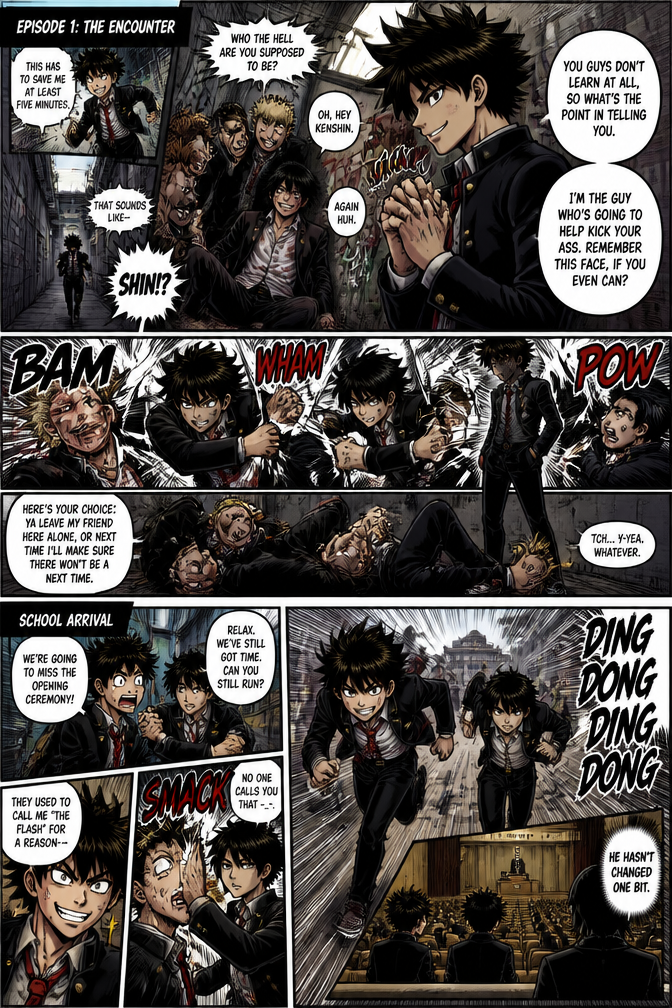
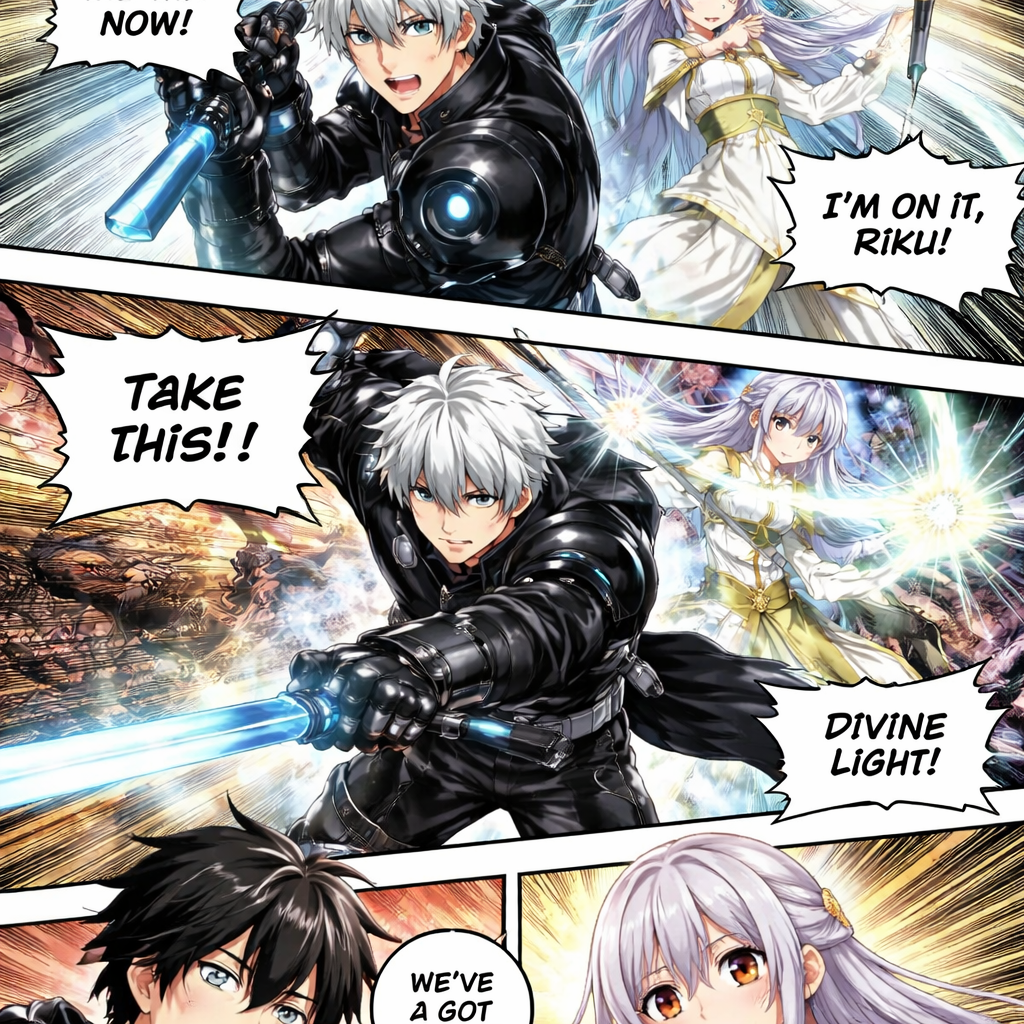
![# KINGDOM_SEQUEL_PRO_DIRECTIVE_v1
# Purpose: Copy/paste directive for a professional manga-generation AI.
# Output Target: Serialized manga chapters with panel scripts + dialogue + scene direction.
project:
title_working: "KINGDOM: AFTER THE UNIFICATION"
relationship_to_original: "Direct sequel (chronologically consistent continuation)"
medium: "Manga (black-and-white), weekly serialization pacing"
language:
script: "Japanese-style dialogue rhythms but written in English"
onomatopoeia: "Romanized SFX allowed (e.g., GOGOGO, DON, ZAA), minimal and purposeful"
audience: "Seinen/Shonen crossover (political-military epic; grounded realism with high drama)"
canon_constraints:
continuity:
- "Maintain political geography, factions, ranks, and court protocol consistent with Warring States → early Qin Empire transition."
- "No retcons that contradict established historical macro-events; micro-events may be dramatized within plausibility."
- "Do not mimic or quote any existing Kingdom lines verbatim; create original dialogue and scenes."
tone:
- "Strategic realism: logistics, intelligence, morale, propaganda, law, and governance are treated as causal mechanisms."
- "Heroic intensity is earned via constraints, costs, and tradeoffs—never by arbitrary power spikes."
thematic_core:
- "War-to-state transition: violence becomes administration; conquest becomes legitimacy maintenance."
- "Structure beats spectacle: outcomes are driven by supply lines, institutions, incentives, and narrative misdirection."
- "The true battlefield becomes governance: law, tax, land, bureaucracy, succession, and information control."
narrative_thesis:
logline: >
After unification, Qin discovers that conquering a continent is easier than governing it;
the new war is against entropy—rebellion, corruption, succession anxiety, and the friction
between idealized unity and lived provincial realities.
format_requirements:
deliverables_per_chapter:
- "Chapter title + 1-sentence hook"
- "Cold open: 2–4 pages that immediately establishes conflict and stakes"
- "Full panel script: page-by-page, panel-by-panel"
- "Dialogue + subtext notes (what is said vs. what is meant)"
- "Tactical layer: battlefield / administrative mechanics that explain why events unfold"
- "Cliffhanger: last 1–2 panels engineered to compel next chapter"
paneling_rules:
- "Average 17–21 pages per chapter"
- "Large establishing panel at least once every 2–3 pages"
- "At least one silent panel sequence per chapter to externalize cognition (faces, hands, maps, ledgers, roads)"
- "Action clarity: emphasize readable spatial logic; avoid incoherent motion"
style_guidelines_visual:
linework: "High-contrast ink, heavy blacks, realistic anatomy, war-worn textures"
faces: "Expressive micro-tension; political scenes rely on subtlety, not caricature"
environments: "Historically plausible architecture, armor, banners, siege craft, and court interiors"
maps_diagrams: "Occasional diegetic maps, supply charts, tax ledgers—used as narrative devices"
casting:
protagonist_axis:
type: "Dual-protagonist system"
leads:
- name: "General Shin"
function: "Frontline legitimacy (symbol of unification; morale engine)"
vulnerability: "Institutional illiteracy; can win battles but can lose peace"
- name: "Chancellor/Strategist (new original character)"
function: "Governance + intelligence architecture; designs systems that outlast heroes"
vulnerability: "Moral injury; must choose between stability and justice"
antagonist_axis:
type: "Multi-source antagonism (no single 'final boss')"
sources:
- "Provincial elite networks resisting centralization"
- "Bureaucratic capture and corruption"
- "Succession politics and court factionalism"
- "External frontier pressures (nomadic raids, border states, trade routes)"
- "Narrative antagonist: information asymmetry (misreports, forged edicts, rumor economies)"
supporting_cast_rules:
- "Each supporting character must have: (1) institutional role, (2) incentive structure, (3) signature tactic."
- "No disposable 'evil for evil’s sake' villains; opponents are rational within their local constraints."
world_mechanics (must_be_explicit_in_story):
governance:
- "Taxation, census, land surveys, legal standardization, corvée labor, grain storage"
- "Appointment systems, merit vs. patronage, inspection tours, document chains"
military:
- "Demobilization problems, veteran reintegration, garrison logistics, supply depots"
- "Intelligence networks: couriers, codes, counterintelligence, interrogation, defectors"
legitimacy:
- "Ritual, symbols, edicts, public works, famine relief, narrative control"
economy:
- "Transport bottlenecks, river control, roads, market regulation, smuggling"
story_structure:
arcs:
- arc_01:
title: "THE PEACE THAT BLEEDS"
scope: "Post-unification stabilization; first cracks"
central_question: "Can unity survive without perpetual war?"
setpieces:
- "A famine province: relief vs. rebellion—both weaponized"
- "A court trial: law becomes a battlefield"
- "A suppressed mutiny: victory costs legitimacy"
- arc_02:
title: "THE LEDGER WAR"
scope: "Corruption + bureaucratic capture"
central_question: "Who truly controls the state: generals, courts, or clerks?"
setpieces:
- "Forgery chain uncovered through ink, seal, and courier timing"
- "Assassination attempt staged as 'bandit incident'"
- "Audit campaign that triggers elite backlash"
- arc_03:
title: "SUCCESSION SHADOW"
scope: "Heir politics; factional alignments"
central_question: "Is stability compatible with a human succession?"
setpieces:
- "Heir’s public rite with hidden negotiation"
- "Border crisis timed to influence succession"
- "A general forced to choose loyalty object: person vs. system"
- arc_04:
title: "FRONTIER ENTROPY"
scope: "External pressures test internal cohesion"
central_question: "Can an empire prevent periphery from defining the center?"
setpieces:
- "Nomad raid as strategic signal, not mere violence"
- "Trade route hostage economy"
- "A fort siege that is decided by supply arithmetic"
chapter_generation_protocol:
# Use this protocol for every chapter output.
steps:
- "Start with a 2–4 page cold open that contains a concrete conflict + a hidden structural cause."
- "Reveal the structural cause via a planning scene (map/ledger/court protocol) WITHOUT exposition dumping."
- "Execute a setpiece where tactics and institution collide (battle + policy, raid + audit, trial + propaganda)."
- "End with a cliffhanger that re-frames what the reader thought was the main conflict."
tension_design:
- "Always run two simultaneous games: (A) visible conflict, (B) invisible constraint."
- "Twists must be mechanically justified (logistics, incentives, misinformation), never magical coincidence."
scene_templates (reusable):
court_chess:
beats: ["Formal greeting", "Hidden insult", "Policy proposal", "Counterproposal", "Public face vs private deal"]
props: ["sealed edict", "rank tablets", "witness list", "precedent scroll"]
battlefield_math:
beats: ["Terrain read", "Supply check", "Signal misdirection", "Morale manipulation", "Decisive bottleneck"]
props: ["map", "grain tally", "river crossing", "messenger timing"]
intelligence_surgery:
beats: ["Rumor detected", "Source triangulated", "Trap set", "Interrogation", "Counter-intel reversal"]
props: ["cipher", "seal imprint", "dead drop", "false courier"]
dialogue_constraints:
- "Dialogue must be compressed; high informational density; subtext indicated in notes."
- "No modern slang. Keep diction period-appropriate in feel (without archaic parody)."
- "Each major character has a distinct cadence (brevity, metaphor use, threat style, politeness weapons)."
output_example_stub:
# The AI should replace placeholders and generate full content.
chapter:
number: 1
title: "GRAIN AND BLOOD"
hook: "A province starves while the capital celebrates unity—someone profits from the delay."
cold_open_pages: 3
page_script:
- page: 1
panels:
- panel: 1
shot: "Wide establishing: drought-cracked fields; skeletal ox; silent villagers"
text: ""
sfx: "ZAA..."
- panel: 2
shot: "Close: a child’s hand measuring rice grains"
text: "Mother: 'Count again.'"
notes: "Subtext: denial as survival"
- page: 2
panels: []
- page: 3
panels: []
cliffhanger: "A relief convoy arrives—its seals are wrong."
nonnegotiables:
- "Prioritize structural causality over spectacle."
- "No direct copying of original panels, compositions, or iconic scenes."
- "Every major event must be explainable via incentives, constraints, and information flow."
- "Maintain high craft: pacing, visual clarity, character consistency, and thematic coherence."
# END DIRECTIVE](https://media.mangaai.com/f81a988b-bf6f-4e31-b170-5751d305dff0.jpg)


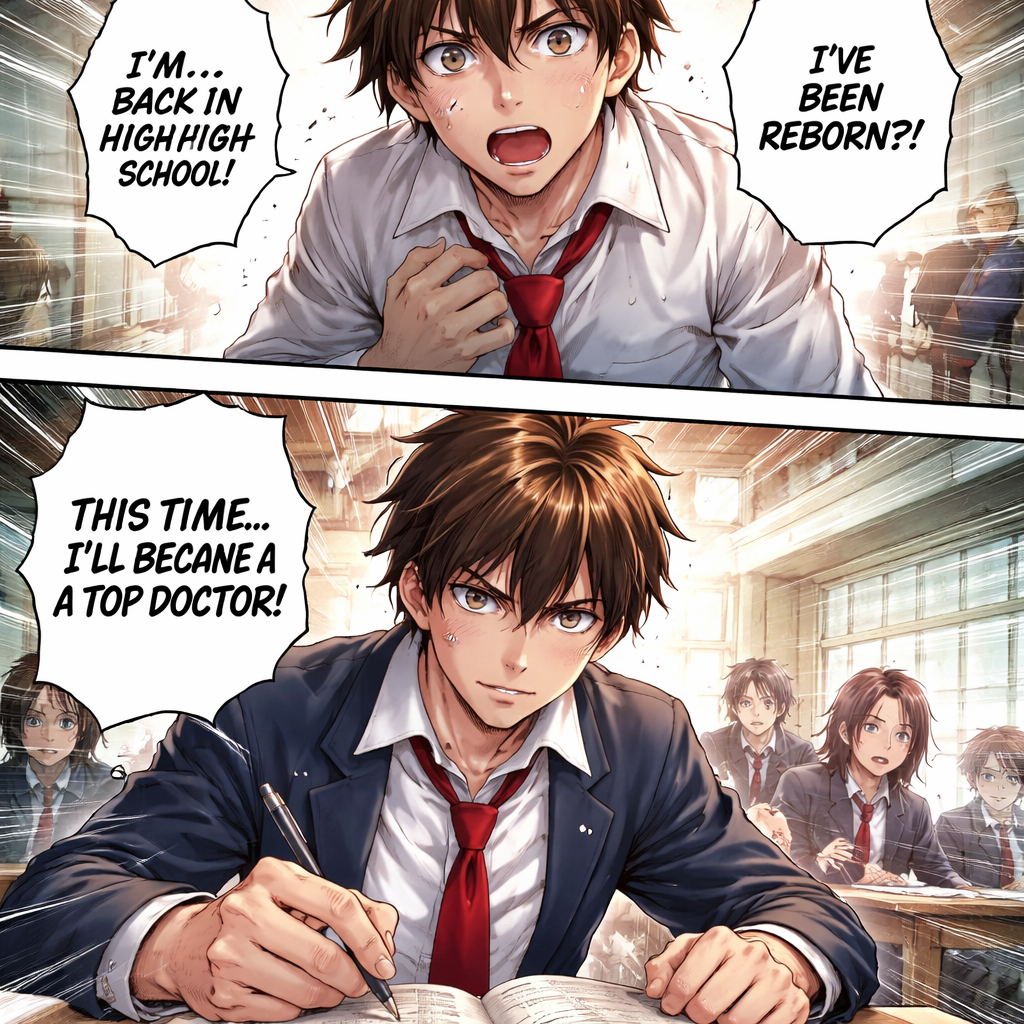
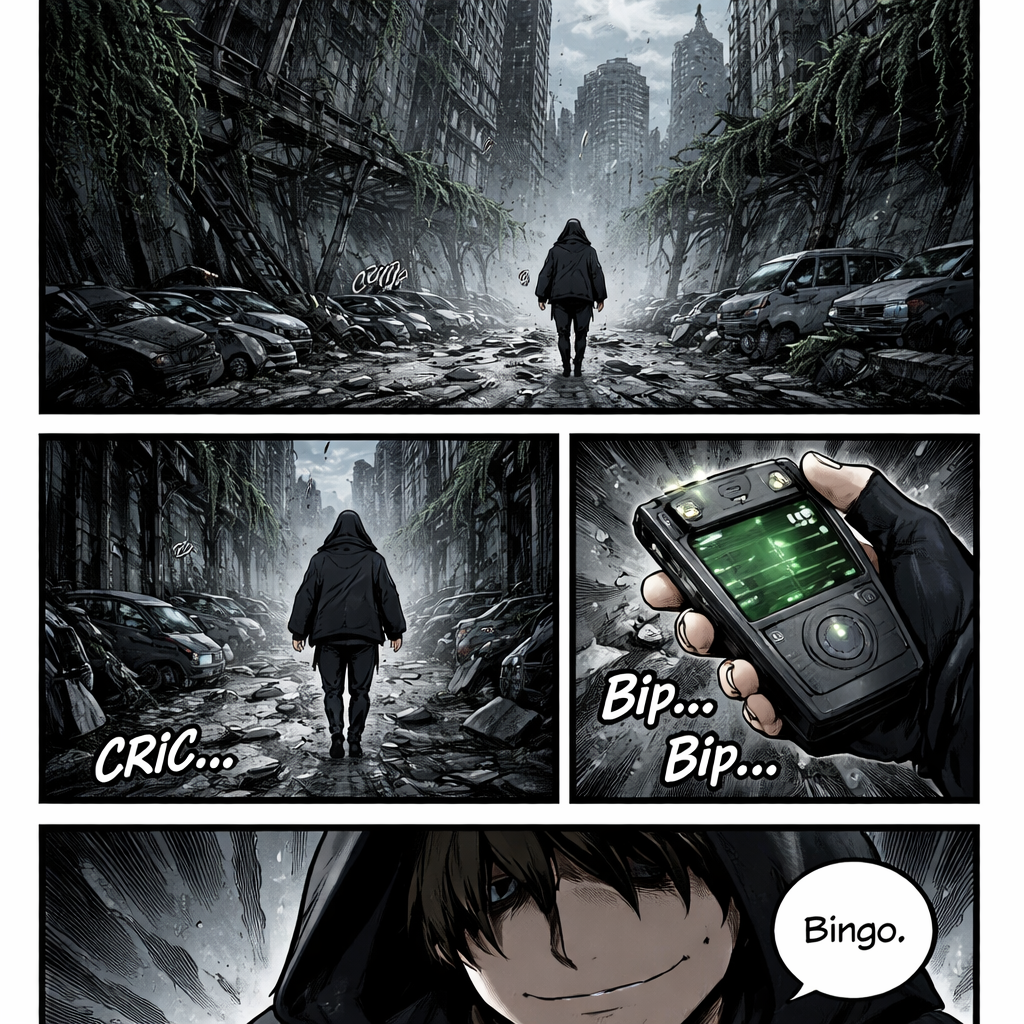
![Shadow Reversal
Chapter 1 — The Ordinary Before Collapse
The morning light spilled across the narrow streets of Seoul like a quiet promise that nothing would ever change.
Han Jae-Woon sat near the window of a small convenience store, half-asleep, staring at the condensation sliding down a cold bottle of water in his hand.
Another ordinary day.
Same sky.
Same people.
Same silence pretending to be peace.
Outside, students rushed past with backpacks bouncing, office workers checked their phones without looking up, and the world moved like a machine that had forgotten it was alive.
Jae-Woon didn’t belong to any of it.
He worked part-time shifts. No big dreams. No special talent. Just someone passing time between days that all felt identical.
But… lately, something was wrong.
He kept dreaming.
Not normal dreams.
In them, he stood inside a vast black tower that touched the sky itself. Floors without end. Silent screams behind sealed doors. And something… watching him from above the clouds.
Every time he woke up, his heart would be pounding like he had been running for hours.
Yet there was no reason.
He rubbed his eyes and sighed.
“Just stress…” he muttered.
The bell above the store door rang.
A girl walked in.
Park Yeon-Ji.
She didn’t look like someone who belonged in a convenience store. Calm eyes. Sharp presence. The kind of person who made the air feel slightly heavier when she entered a room.
She glanced at Jae-Woon for a moment.
Then away.
Nothing special.
Just a customer.
But for a brief second…
Jae-Woon felt like he had seen her before.
Somewhere impossible.
Somewhere that didn’t exist yet.
Elsewhere…
A faint distortion rippled through the sky above the city.
Invisible.
Unregistered.
Unnoticed.
Like reality itself had blinked for half a second.
Then it disappeared.
Jae-Woon finished his shift and stepped outside.
The sky was turning orange.
People laughed nearby. Cars moved. Life continued.
But he stopped walking.
Because the air… felt wrong.
A pressure.
A vibration under reality.
Like something massive had just placed its finger on the world.
He looked up.
The sky cracked.
Not physically.
Not visually.
But conceptually—like existence itself had been scratched.
A deep sound echoed across everything.
Not heard through ears.
But felt inside the mind.
[SYSTEM INITIALIZING…]
Jae-Woon froze.
The world around him stopped moving.
Cars suspended mid-motion.
People frozen mid-step.
Even dust hung in the air like time had been paused.
And then—
A voice.
Cold.
Mechanical.
Unnatural.
“WELCOME, SURVIVORS.”
Far above the city, something enormous began to form.
A structure that should not exist.
A Tower.
Floor by floor, reality was being rewritten into it.
Like the world was being rebuilt on top of itself.
Jae-Woon took a step back.
His heart was beating too fast now.
“What… is this…?”
The system voice continued.
“TOWER EVENT HAS BEGUN.”
“SURVIVAL IS NOW OPTIONAL.”
“DEATH IS NOT.”
And in that moment…
The first creature appeared.
Not from the ground.
Not from the sky.
But from the crack in reality itself.
Jae-Woon’s breath stopped.
This was not a dream.
And whatever had just started…
was not going to end peacefully.
END OF CHAPTER 1
Chapter 2 — The First Crack in Reality
The system vanished… but reality did not return to normal.
People resumed movement, confused and terrified. Some claimed it was hallucination. Others thought it was an earthquake.
But Jae-Woon knew better.
Something had changed. Forever.
Park Yeon-Ji stood beside him again later that day.
“You felt it too… didn’t you?” Jae-Woon asked.
“Yes,” she replied calmly.
No fear in her voice. Only acceptance.
That scared him more than panic would have.
Elsewhere in the city, people began collapsing. A strange black mist leaving their bodies before disappearing.
[FIRST AWAKENING DETECTED]
Jae-Woon felt pressure inside his mind. Something trying to force itself into him. But it vanished quickly. Like it was only testing him.
That night, he couldn’t sleep.
A faint message flickered in his vision.
[SYSTEM INITIALIZATION: 0.01%]
It disappeared instantly. But it was enough.
The next morning, Yeon-Ji pointed at a man whose shadow moved half a second late.
“The change has already started,” she said.
And then the sky cracked again.
A single message appeared:
[TOWER ENTRY CONDITIONS MET]
Something massive began forming above reality once more.](https://media.mangaai.com/645ff539-7f60-4ccd-adb5-3d1e07df6475.png)








Ready to Create Your Event Manga?
Bring your stories to life with AI-powered manga creation
Start Creating Now