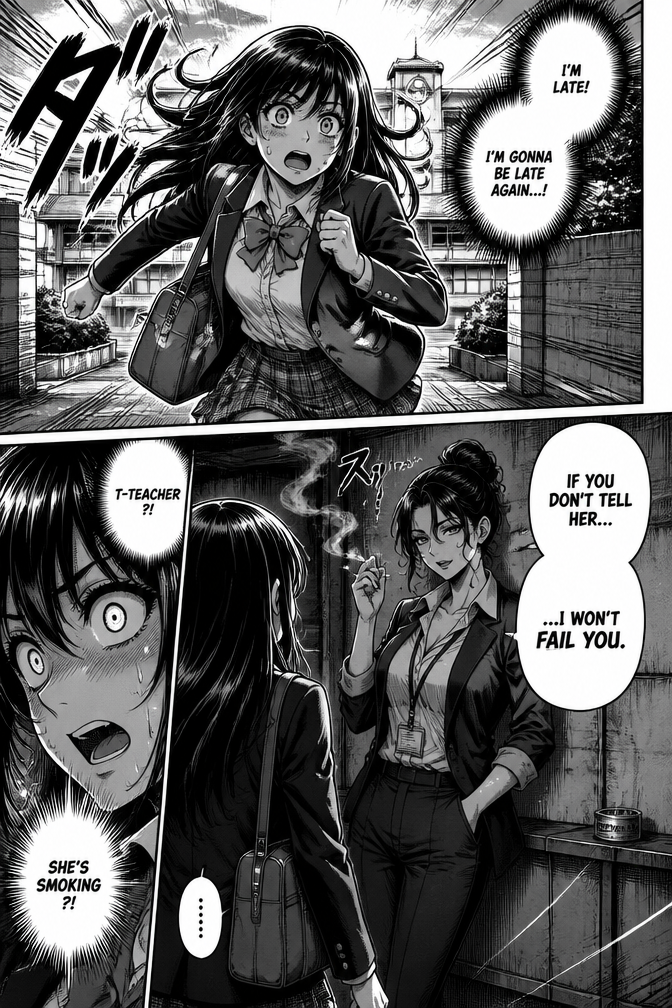
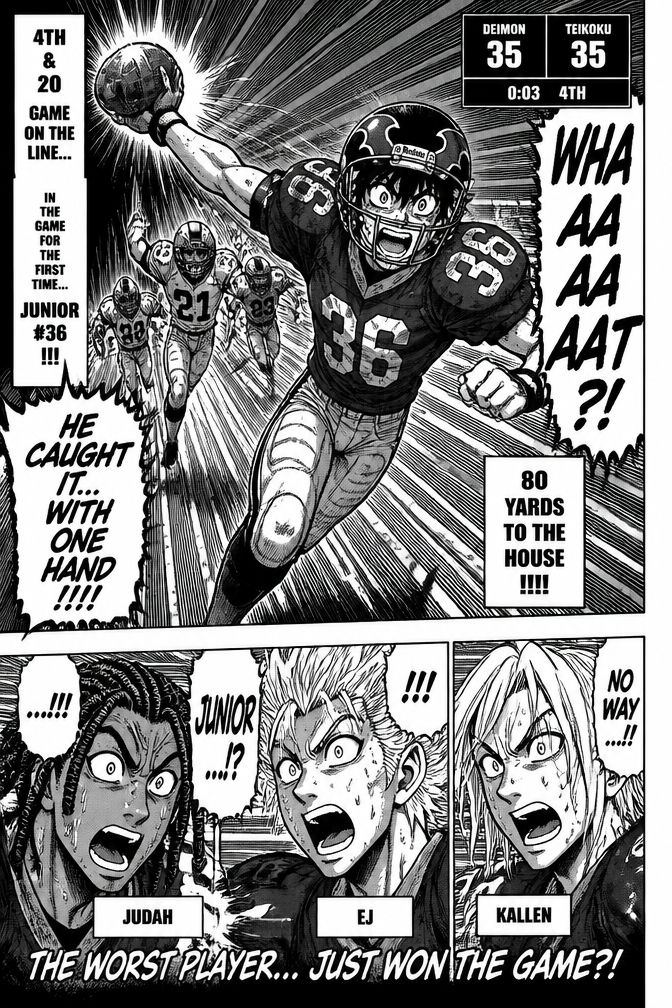
![# KINGDOM_SEQUEL_PRO_DIRECTIVE_v1
# Purpose: Copy/paste directive for a professional manga-generation AI.
# Output Target: Serialized manga chapters with panel scripts + dialogue + scene direction.
project:
title_working: "KINGDOM: AFTER THE UNIFICATION"
relationship_to_original: "Direct sequel (chronologically consistent continuation)"
medium: "Manga (black-and-white), weekly serialization pacing"
language:
script: "Japanese-style dialogue rhythms but written in English"
onomatopoeia: "Romanized SFX allowed (e.g., GOGOGO, DON, ZAA), minimal and purposeful"
audience: "Seinen/Shonen crossover (political-military epic; grounded realism with high drama)"
canon_constraints:
continuity:
- "Maintain political geography, factions, ranks, and court protocol consistent with Warring States → early Qin Empire transition."
- "No retcons that contradict established historical macro-events; micro-events may be dramatized within plausibility."
- "Do not mimic or quote any existing Kingdom lines verbatim; create original dialogue and scenes."
tone:
- "Strategic realism: logistics, intelligence, morale, propaganda, law, and governance are treated as causal mechanisms."
- "Heroic intensity is earned via constraints, costs, and tradeoffs—never by arbitrary power spikes."
thematic_core:
- "War-to-state transition: violence becomes administration; conquest becomes legitimacy maintenance."
- "Structure beats spectacle: outcomes are driven by supply lines, institutions, incentives, and narrative misdirection."
- "The true battlefield becomes governance: law, tax, land, bureaucracy, succession, and information control."
narrative_thesis:
logline: >
After unification, Qin discovers that conquering a continent is easier than governing it;
the new war is against entropy—rebellion, corruption, succession anxiety, and the friction
between idealized unity and lived provincial realities.
format_requirements:
deliverables_per_chapter:
- "Chapter title + 1-sentence hook"
- "Cold open: 2–4 pages that immediately establishes conflict and stakes"
- "Full panel script: page-by-page, panel-by-panel"
- "Dialogue + subtext notes (what is said vs. what is meant)"
- "Tactical layer: battlefield / administrative mechanics that explain why events unfold"
- "Cliffhanger: last 1–2 panels engineered to compel next chapter"
paneling_rules:
- "Average 17–21 pages per chapter"
- "Large establishing panel at least once every 2–3 pages"
- "At least one silent panel sequence per chapter to externalize cognition (faces, hands, maps, ledgers, roads)"
- "Action clarity: emphasize readable spatial logic; avoid incoherent motion"
style_guidelines_visual:
linework: "High-contrast ink, heavy blacks, realistic anatomy, war-worn textures"
faces: "Expressive micro-tension; political scenes rely on subtlety, not caricature"
environments: "Historically plausible architecture, armor, banners, siege craft, and court interiors"
maps_diagrams: "Occasional diegetic maps, supply charts, tax ledgers—used as narrative devices"
casting:
protagonist_axis:
type: "Dual-protagonist system"
leads:
- name: "General Shin"
function: "Frontline legitimacy (symbol of unification; morale engine)"
vulnerability: "Institutional illiteracy; can win battles but can lose peace"
- name: "Chancellor/Strategist (new original character)"
function: "Governance + intelligence architecture; designs systems that outlast heroes"
vulnerability: "Moral injury; must choose between stability and justice"
antagonist_axis:
type: "Multi-source antagonism (no single 'final boss')"
sources:
- "Provincial elite networks resisting centralization"
- "Bureaucratic capture and corruption"
- "Succession politics and court factionalism"
- "External frontier pressures (nomadic raids, border states, trade routes)"
- "Narrative antagonist: information asymmetry (misreports, forged edicts, rumor economies)"
supporting_cast_rules:
- "Each supporting character must have: (1) institutional role, (2) incentive structure, (3) signature tactic."
- "No disposable 'evil for evil’s sake' villains; opponents are rational within their local constraints."
world_mechanics (must_be_explicit_in_story):
governance:
- "Taxation, census, land surveys, legal standardization, corvée labor, grain storage"
- "Appointment systems, merit vs. patronage, inspection tours, document chains"
military:
- "Demobilization problems, veteran reintegration, garrison logistics, supply depots"
- "Intelligence networks: couriers, codes, counterintelligence, interrogation, defectors"
legitimacy:
- "Ritual, symbols, edicts, public works, famine relief, narrative control"
economy:
- "Transport bottlenecks, river control, roads, market regulation, smuggling"
story_structure:
arcs:
- arc_01:
title: "THE PEACE THAT BLEEDS"
scope: "Post-unification stabilization; first cracks"
central_question: "Can unity survive without perpetual war?"
setpieces:
- "A famine province: relief vs. rebellion—both weaponized"
- "A court trial: law becomes a battlefield"
- "A suppressed mutiny: victory costs legitimacy"
- arc_02:
title: "THE LEDGER WAR"
scope: "Corruption + bureaucratic capture"
central_question: "Who truly controls the state: generals, courts, or clerks?"
setpieces:
- "Forgery chain uncovered through ink, seal, and courier timing"
- "Assassination attempt staged as 'bandit incident'"
- "Audit campaign that triggers elite backlash"
- arc_03:
title: "SUCCESSION SHADOW"
scope: "Heir politics; factional alignments"
central_question: "Is stability compatible with a human succession?"
setpieces:
- "Heir’s public rite with hidden negotiation"
- "Border crisis timed to influence succession"
- "A general forced to choose loyalty object: person vs. system"
- arc_04:
title: "FRONTIER ENTROPY"
scope: "External pressures test internal cohesion"
central_question: "Can an empire prevent periphery from defining the center?"
setpieces:
- "Nomad raid as strategic signal, not mere violence"
- "Trade route hostage economy"
- "A fort siege that is decided by supply arithmetic"
chapter_generation_protocol:
# Use this protocol for every chapter output.
steps:
- "Start with a 2–4 page cold open that contains a concrete conflict + a hidden structural cause."
- "Reveal the structural cause via a planning scene (map/ledger/court protocol) WITHOUT exposition dumping."
- "Execute a setpiece where tactics and institution collide (battle + policy, raid + audit, trial + propaganda)."
- "End with a cliffhanger that re-frames what the reader thought was the main conflict."
tension_design:
- "Always run two simultaneous games: (A) visible conflict, (B) invisible constraint."
- "Twists must be mechanically justified (logistics, incentives, misinformation), never magical coincidence."
scene_templates (reusable):
court_chess:
beats: ["Formal greeting", "Hidden insult", "Policy proposal", "Counterproposal", "Public face vs private deal"]
props: ["sealed edict", "rank tablets", "witness list", "precedent scroll"]
battlefield_math:
beats: ["Terrain read", "Supply check", "Signal misdirection", "Morale manipulation", "Decisive bottleneck"]
props: ["map", "grain tally", "river crossing", "messenger timing"]
intelligence_surgery:
beats: ["Rumor detected", "Source triangulated", "Trap set", "Interrogation", "Counter-intel reversal"]
props: ["cipher", "seal imprint", "dead drop", "false courier"]
dialogue_constraints:
- "Dialogue must be compressed; high informational density; subtext indicated in notes."
- "No modern slang. Keep diction period-appropriate in feel (without archaic parody)."
- "Each major character has a distinct cadence (brevity, metaphor use, threat style, politeness weapons)."
output_example_stub:
# The AI should replace placeholders and generate full content.
chapter:
number: 1
title: "GRAIN AND BLOOD"
hook: "A province starves while the capital celebrates unity—someone profits from the delay."
cold_open_pages: 3
page_script:
- page: 1
panels:
- panel: 1
shot: "Wide establishing: drought-cracked fields; skeletal ox; silent villagers"
text: ""
sfx: "ZAA..."
- panel: 2
shot: "Close: a child’s hand measuring rice grains"
text: "Mother: 'Count again.'"
notes: "Subtext: denial as survival"
- page: 2
panels: []
- page: 3
panels: []
cliffhanger: "A relief convoy arrives—its seals are wrong."
nonnegotiables:
- "Prioritize structural causality over spectacle."
- "No direct copying of original panels, compositions, or iconic scenes."
- "Every major event must be explainable via incentives, constraints, and information flow."
- "Maintain high craft: pacing, visual clarity, character consistency, and thematic coherence."
# END DIRECTIVE](https://media.mangaai.com/f81a988b-bf6f-4e31-b170-5751d305dff0.jpg)
Manga Story
# KINGDOM_SEQUEL_PRO_DIRECTIVE_v1 # Purpose: Copy/paste directive for a professional manga-generation AI. # Output Target: Serialized manga chapters with panel scripts + dialogue + scene direction. project: title_working: "KINGDOM: AFTER THE UNIFICATION" relationship_to_original: "Direct sequel (chronologically consistent continuation)" medium: "Manga (black-and-white), weekly serialization pacing" language: script: "Japanese-style dialogue rhythms but written in English" onomatopoeia: "Romanized SFX allowed (e.g., GOGOGO, DON, ZAA), minimal and purposeful" audience: "Seinen/Shonen crossover (political-military epic; grounded realism with high drama)" canon_constraints: continuity: - "Maintain political geography, factions, ranks, and court protocol consistent with Warring States → early Qin Empire transition." - "No retcons that contradict established historical macro-events; micro-events may be dramatized within plausibility." - "Do not mimic or quote any existing Kingdom lines verbatim; create original dialogue and scenes." tone: - "Strategic realism: logistics, intelligence, morale, propaganda, law, and governance are treated as causal mechanisms." - "Heroic intensity is earned via constraints, costs, and tradeoffs—never by arbitrary power spikes." thematic_core: - "War-to-state transition: violence becomes administration; conquest becomes legitimacy maintenance." - "Structure beats spectacle: outcomes are driven by supply lines, institutions, incentives, and narrative misdirection." - "The true battlefield becomes governance: law, tax, land, bureaucracy, succession, and information control." narrative_thesis: logline: > After unification, Qin discovers that conquering a continent is easier than governing it; the new war is against entropy—rebellion, corruption, succession anxiety, and the friction between idealized unity and lived provincial realities. format_requirements: deliverables_per_chapter: - "Chapter title + 1-sentence hook" - "Cold open: 2–4 pages that immediately establishes conflict and stakes" - "Full panel script: page-by-page, panel-by-panel" - "Dialogue + subtext notes (what is said vs. what is meant)" - "Tactical layer: battlefield / administrative mechanics that explain why events unfold" - "Cliffhanger: last 1–2 panels engineered to compel next chapter" paneling_rules: - "Average 17–21 pages per chapter" - "Large establishing panel at least once every 2–3 pages" - "At least one silent panel sequence per chapter to externalize cognition (faces, hands, maps, ledgers, roads)" - "Action clarity: emphasize readable spatial logic; avoid incoherent motion" style_guidelines_visual: linework: "High-contrast ink, heavy blacks, realistic anatomy, war-worn textures" faces: "Expressive micro-tension; political scenes rely on subtlety, not caricature" environments: "Historically plausible architecture, armor, banners, siege craft, and court interiors" maps_diagrams: "Occasional diegetic maps, supply charts, tax ledgers—used as narrative devices" casting: protagonist_axis: type: "Dual-protagonist system" leads: - name: "General Shin" function: "Frontline legitimacy (symbol of unification; morale engine)" vulnerability: "Institutional illiteracy; can win battles but can lose peace" - name: "Chancellor/Strategist (new original character)" function: "Governance + intelligence architecture; designs systems that outlast heroes" vulnerability: "Moral injury; must choose between stability and justice" antagonist_axis: type: "Multi-source antagonism (no single 'final boss')" sources: - "Provincial elite networks resisting centralization" - "Bureaucratic capture and corruption" - "Succession politics and court factionalism" - "External frontier pressures (nomadic raids, border states, trade routes)" - "Narrative antagonist: information asymmetry (misreports, forged edicts, rumor economies)" supporting_cast_rules: - "Each supporting character must have: (1) institutional role, (2) incentive structure, (3) signature tactic." - "No disposable 'evil for evil’s sake' villains; opponents are rational within their local constraints." world_mechanics (must_be_explicit_in_story): governance: - "Taxation, census, land surveys, legal standardization, corvée labor, grain storage" - "Appointment systems, merit vs. patronage, inspection tours, document chains" military: - "Demobilization problems, veteran reintegration, garrison logistics, supply depots" - "Intelligence networks: couriers, codes, counterintelligence, interrogation, defectors" legitimacy: - "Ritual, symbols, edicts, public works, famine relief, narrative control" economy: - "Transport bottlenecks, river control, roads, market regulation, smuggling" story_structure: arcs: - arc_01: title: "THE PEACE THAT BLEEDS" scope: "Post-unification stabilization; first cracks" central_question: "Can unity survive without perpetual war?" setpieces: - "A famine province: relief vs. rebellion—both weaponized" - "A court trial: law becomes a battlefield" - "A suppressed mutiny: victory costs legitimacy" - arc_02: title: "THE LEDGER WAR" scope: "Corruption + bureaucratic capture" central_question: "Who truly controls the state: generals, courts, or clerks?" setpieces: - "Forgery chain uncovered through ink, seal, and courier timing" - "Assassination attempt staged as 'bandit incident'" - "Audit campaign that triggers elite backlash" - arc_03: title: "SUCCESSION SHADOW" scope: "Heir politics; factional alignments" central_question: "Is stability compatible with a human succession?" setpieces: - "Heir’s public rite with hidden negotiation" - "Border crisis timed to influence succession" - "A general forced to choose loyalty object: person vs. system" - arc_04: title: "FRONTIER ENTROPY" scope: "External pressures test internal cohesion" central_question: "Can an empire prevent periphery from defining the center?" setpieces: - "Nomad raid as strategic signal, not mere violence" - "Trade route hostage economy" - "A fort siege that is decided by supply arithmetic" chapter_generation_protocol: # Use this protocol for every chapter output. steps: - "Start with a 2–4 page cold open that contains a concrete conflict + a hidden structural cause." - "Reveal the structural cause via a planning scene (map/ledger/court protocol) WITHOUT exposition dumping." - "Execute a setpiece where tactics and institution collide (battle + policy, raid + audit, trial + propaganda)." - "End with a cliffhanger that re-frames what the reader thought was the main conflict." tension_design: - "Always run two simultaneous games: (A) visible conflict, (B) invisible constraint." - "Twists must be mechanically justified (logistics, incentives, misinformation), never magical coincidence." scene_templates (reusable): court_chess: beats: ["Formal greeting", "Hidden insult", "Policy proposal", "Counterproposal", "Public face vs private deal"] props: ["sealed edict", "rank tablets", "witness list", "precedent scroll"] battlefield_math: beats: ["Terrain read", "Supply check", "Signal misdirection", "Morale manipulation", "Decisive bottleneck"] props: ["map", "grain tally", "river crossing", "messenger timing"] intelligence_surgery: beats: ["Rumor detected", "Source triangulated", "Trap set", "Interrogation", "Counter-intel reversal"] props: ["cipher", "seal imprint", "dead drop", "false courier"] dialogue_constraints: - "Dialogue must be compressed; high informational density; subtext indicated in notes." - "No modern slang. Keep diction period-appropriate in feel (without archaic parody)." - "Each major character has a distinct cadence (brevity, metaphor use, threat style, politeness weapons)." output_example_stub: # The AI should replace placeholders and generate full content. chapter: number: 1 title: "GRAIN AND BLOOD" hook: "A province starves while the capital celebrates unity—someone profits from the delay." cold_open_pages: 3 page_script: - page: 1 panels: - panel: 1 shot: "Wide establishing: drought-cracked fields; skeletal ox; silent villagers" text: "" sfx: "ZAA..." - panel: 2 shot: "Close: a child’s hand measuring rice grains" text: "Mother: 'Count again.'" notes: "Subtext: denial as survival" - page: 2 panels: [] - page: 3 panels: [] cliffhanger: "A relief convoy arrives—its seals are wrong." nonnegotiables: - "Prioritize structural causality over spectacle." - "No direct copying of original panels, compositions, or iconic scenes." - "Every major event must be explainable via incentives, constraints, and information flow." - "Maintain high craft: pacing, visual clarity, character consistency, and thematic coherence." # END DIRECTIVE
Related Tags
More Manga to Explore
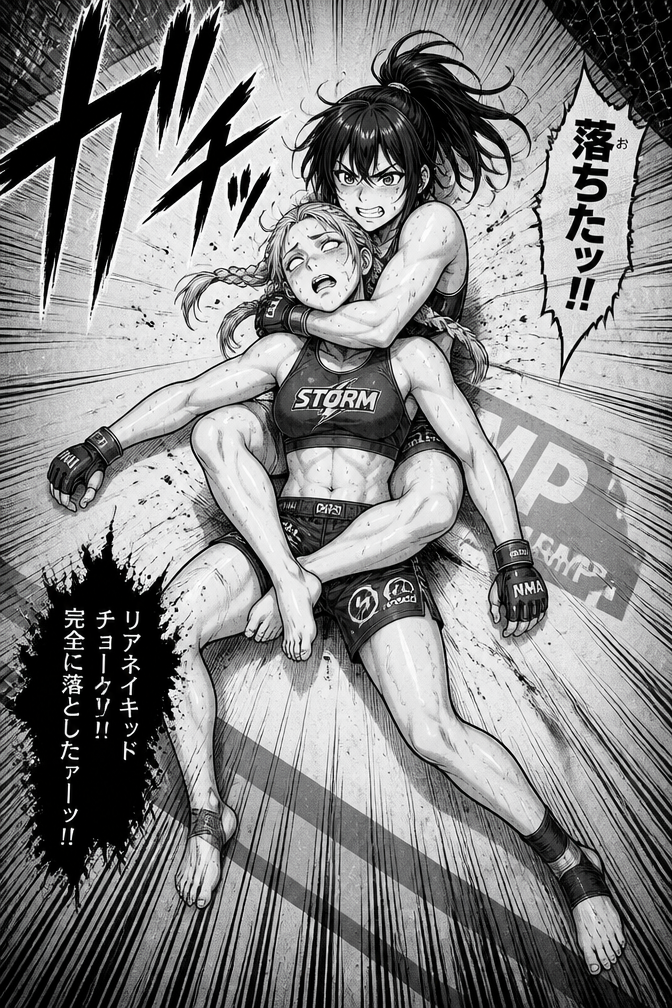
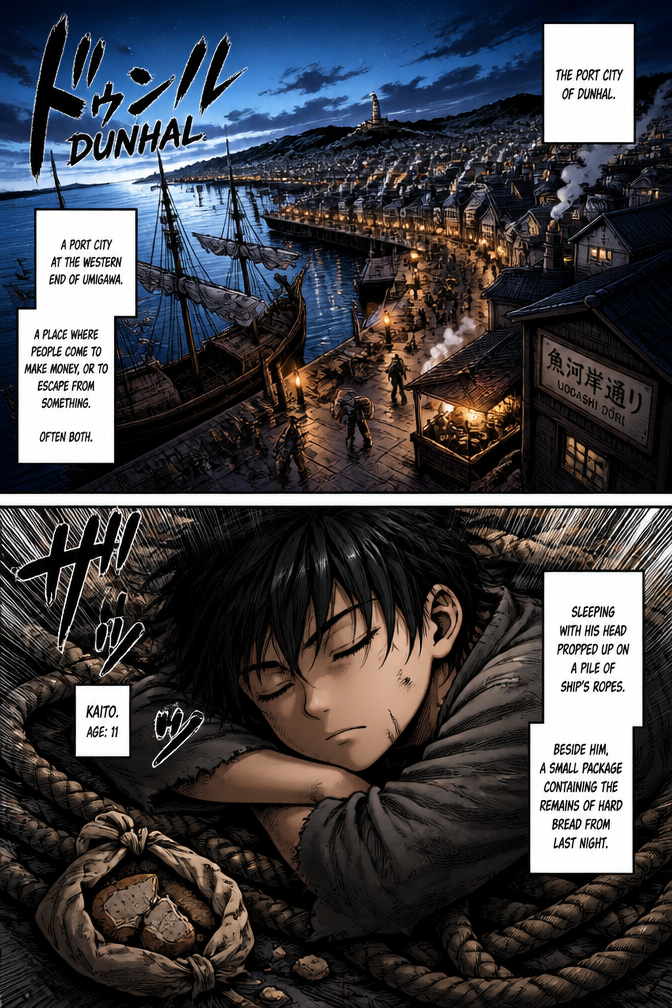
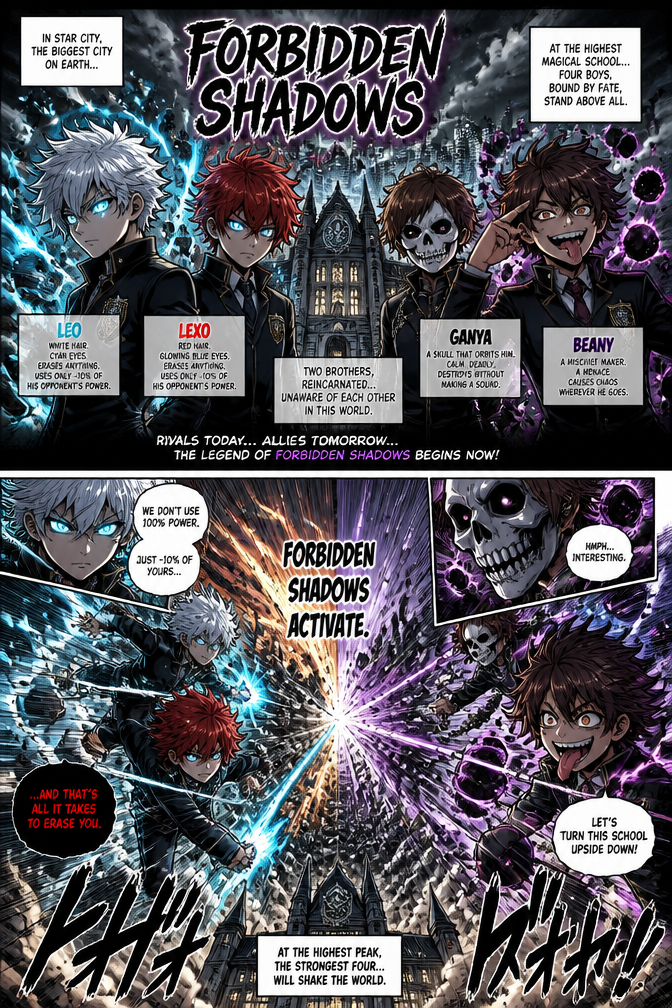
![ADEGAN 1 — EKSTERIOR, HALAMAN KOSONG — SIANG
[Shot wide]
Sebuah halaman beton kosong. Langit cerah. Angin kecil menggulung satu daun kering lewat frame. Tidak ada siapa-siapa.
Suara: Angin sepoi, langkah kaki kecil di kejauhan.
---
ADEGAN 2 — EKSTERIOR, SAMA — LANJUTAN
[Shot medium dari samping]
Cewek masuk frame dari kiri. Rambut berantakan, baju lusuh, ekspresi capek berat. Menyeret kursi kayu dengan satu tangan.
Suara: Gesekan kaki kursi di beton. Sreeet... sreeet...
Dia berhenti di tengah frame. Taruh kursi dengan hati-hati. Mengelap keringat. Duduk. Wajahnya berubah dari capek jadi senyum damai.
Dia menutup mata. Menghirup napas panjang. Puas.
Suara: Desah napas lega.
---
ADEGAN 3 — EKSTERIOR, SAMA — LANJUTAN
[Shot wide]
Dari sisi kanan frame, Cowok muncul. Berjalan tanpa suara. Postur lurus kaku. Ekspresi benar-benar datar, mata setengah tertutup.
Dia berhenti tepat di samping kursi, berdiri menghadap depan. Tidak melihat si Cewek. Tidak melihat kursi. Hanya... ada.
Suara: Hening. Angin.
Cewek membuka satu mata. Melirik ke atas ke arah Cowok.
---
ADEGAN 4 — INTERAKSI PERTAMA
[Shot medium, framing keduanya]
Cewek menunjuk dirinya sendiri, lalu menunjuk kursi. "Ini aku. Kursi."
Cowok melirik dengan mata super lambat. Dari bola mata bawah, naik sedikit. Melihat Cewek. Melihat kursi. Kembali melihat lurus ke depan. Tidak bereaksi.
Cewek berdiri. Gestur mempersilakan duduk dengan dua tangan. Wajah ramah.
Cowok menggeleng kecil. Sekali. Datar.
---
ADEGAN 5 — LOOP TAWAR-MENAWAR
[Shot close-up bergantian, tempo makin cepat]
Cewek menawarkan kursi — gestur lebih besar.
Cowok menolak — geleng makin tipis.
Cut ke Cewek: menawarkan dengan mata melotot.
Cut ke Cowok: geleng dengan mata masih setengah tutup.
Cut ke Cewek: menawarkan sambil melompat kecil.
Cut ke Cowok: geleng sambil memejamkan mata.
Speed ramp: Sekarang bergantian super cepat. Gestur tawaran makin absurd — Cewek menunjuk kursi, tepuk kursi, gosok-gosok kursi, peluk kursi, angkat kursi ke arah Cowok. Cowok tetap menggeleng datar di setiap cut.
Suara: Whoosh whoosh whoosh makin cepat. Lalu tiba-tiba...
HENTI TOTAL.
Suara: Record scratch. Hening.
---
ADEGAN 6 — LEDAKAN
[Shot wide]
Cewek diam membeku. Senyumnya patah. Wajahnya berubah jadi gelap, bayangan menutupi mata.
Dia mengangkat kursi tinggi-tinggi di atas kepala dengan dua tangan. Pose seperti mau banting.
Mulutnya terbuka (seolah teriak, tapi tanpa suara).
LEMPAR KERAS. Kursi keluar frame kanan.
Suara: BRAAAK... creak... creak... (suara kursi jatuh berdebum, lalu goyang-goyang di luar frame, akhirnya diam)
---
ADEGAN 7 — HENING PASCA BADAI
[Shot medium, dua karakter berdiri]
Keduanya berdiri. Tanpa kursi. Saling berhadapan dari jarak dua meter.
Cowok menatap Cewek. Cewek menatap Cowok. Nafas Cewek masih naik turun karena emosi.
Cowok... masih datar. Tidak terpengaruh sama sekali.
Angin lewat lagi. Daun kering yang sama dari Adegan 1 lewat lagi.
Suara: Angin sepoi.
---
ADEGAN 8 — PUNCHLINE PERTAMA
[Shot close-up ke tangan Cowok]
Tangan Cowok masuk ke saku celana. Gerakan super lambat.
Klik... (bunyi logam kecil)
Tangannya keluar. Memegang sesuatu yang terlipat. Kecil. Persegi panjang.
Dia letakkan di tanah.
Klik... klik... klik... Dibukanya dengan tiga gerakan terpisah dan lambat.
Sekarang terlihat: kursi lipat kecil. Sangat kecil. Hanya cukup untuk pantatnya sendiri.
---
ADEGAN 9 — DUDUK
[Shot medium dari depan]
Cowok duduk. Pelan. Punggung lurus. Tangan di paha. Lutut naik karena kursi terlalu pendek. Tapi dia duduk dengan postur sempurna.
Dia menutup mata. Menghembuskan napas dari hidung kecil. Wajahnya tetap datar, tapi ada sedikit sudut bibir naik. Puas versinya sendiri.
Cewek melihat semua ini dari sisi kiri frame. Mulutnya menganga. Mata melebar. Seluruh tubuhnya membeku.
Suara: Cricket sound. Jangkrik.
---
ADEGAN 10 — TWIST AKHIR
[Shot wide]
Cewek berjalan mendekat. Bukan ke kursi lipat. Bukan ke depan Cowok. Tapi ke... samping-belakang Cowok.
Cowok masih duduk dengan mata terpejam.
Cewek berdiri tepat di belakangnya. Mengukur jarak. Membidik.
Dia jongkok sebentar, lalu...
DUDUK DI ATAS KEPALA COWOK.
---
ADEGAN 11 — FREEZE FINAL
[Shot medium dari depan, framing sempurna]
Cowok duduk di kursi lipat kecil. Postur tetap lurus. Mata masih terpejam. Tapi sekarang muncul satu tetes keringat besar di pelipisnya.
Di atas kepalanya, Cewek duduk bersila. Senyum puas kembali ke wajahnya. Mata tertutup. Damai. Seperti di Adegan 2.
Keduanya diam.
Kamera hold 3 detik.
Kartu judul muncul:
"KURSI"
Suara: Pop kecil saat judul muncul. Lalu sunyi.
FIN.](https://media.mangaai.com/c8988f36-016b-4e6a-b8f4-96cc9c693303.png)