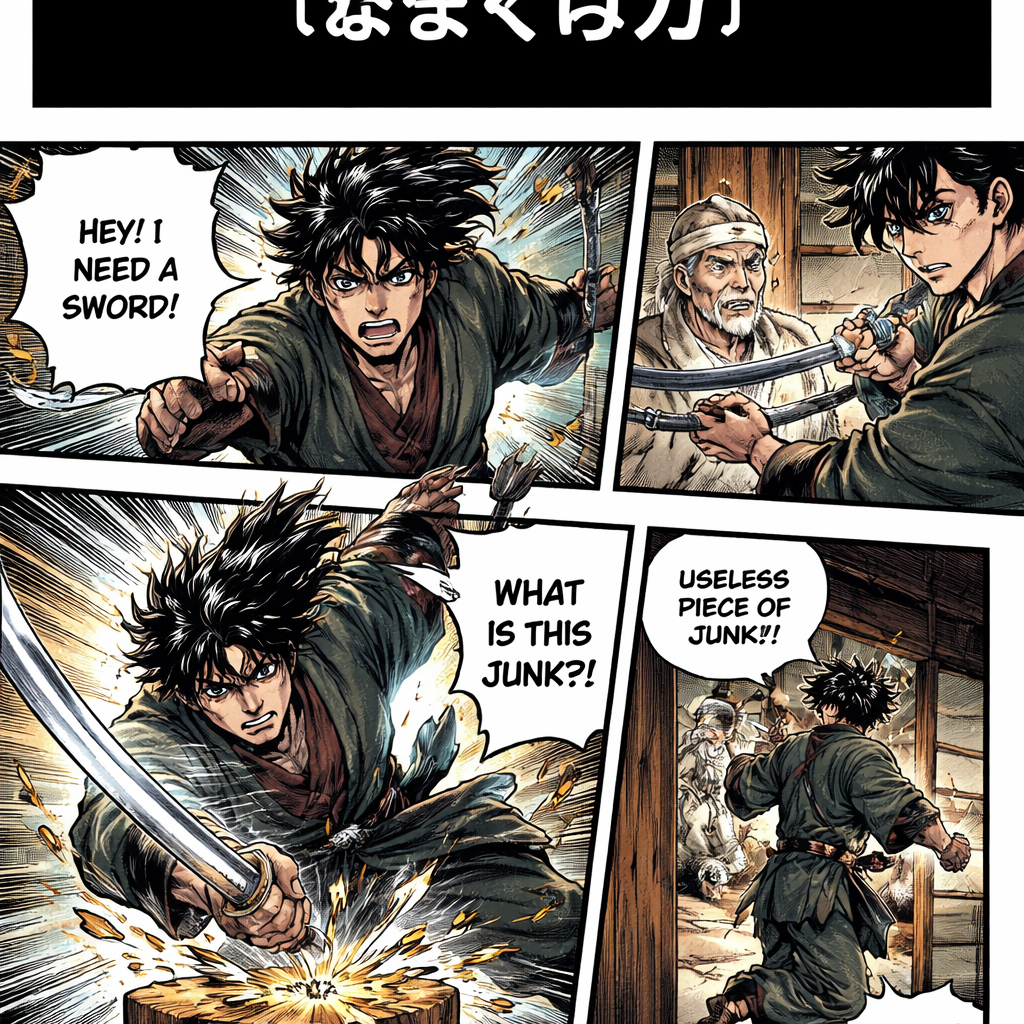
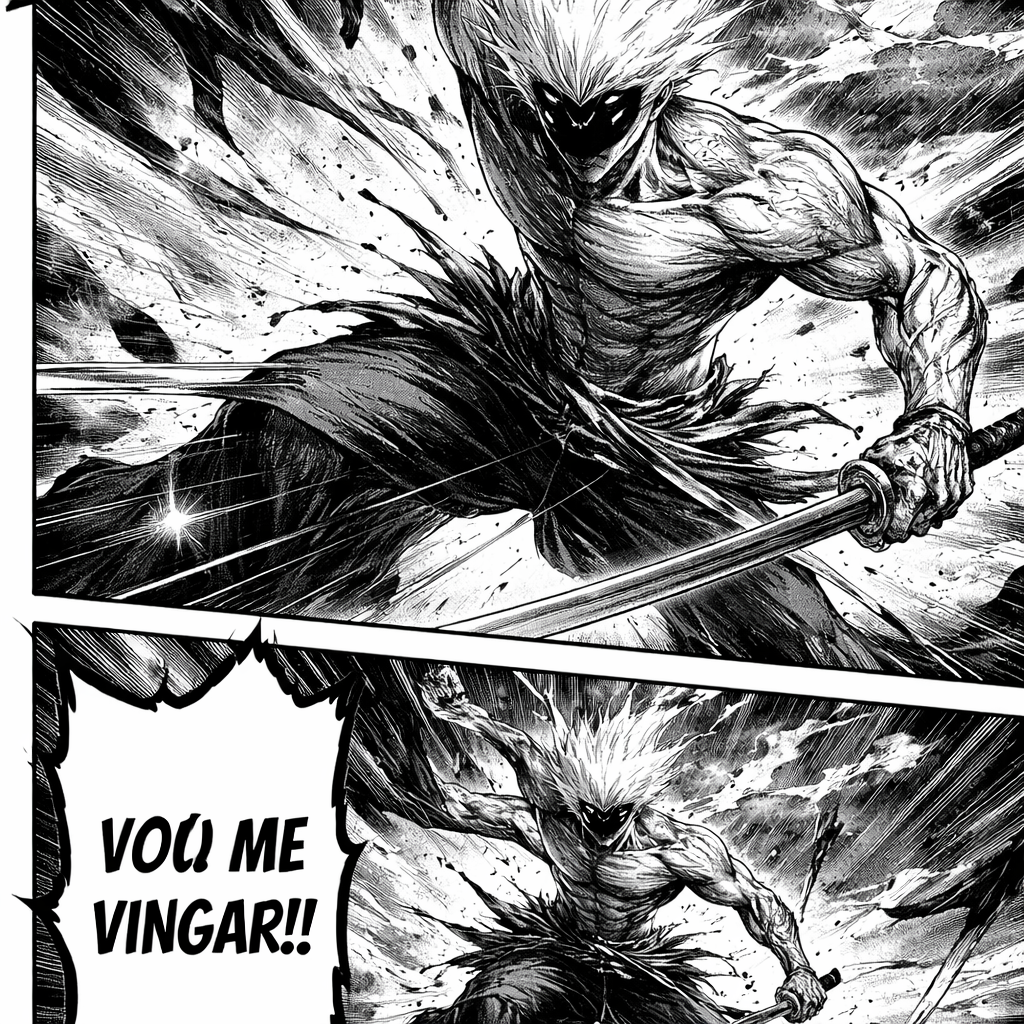
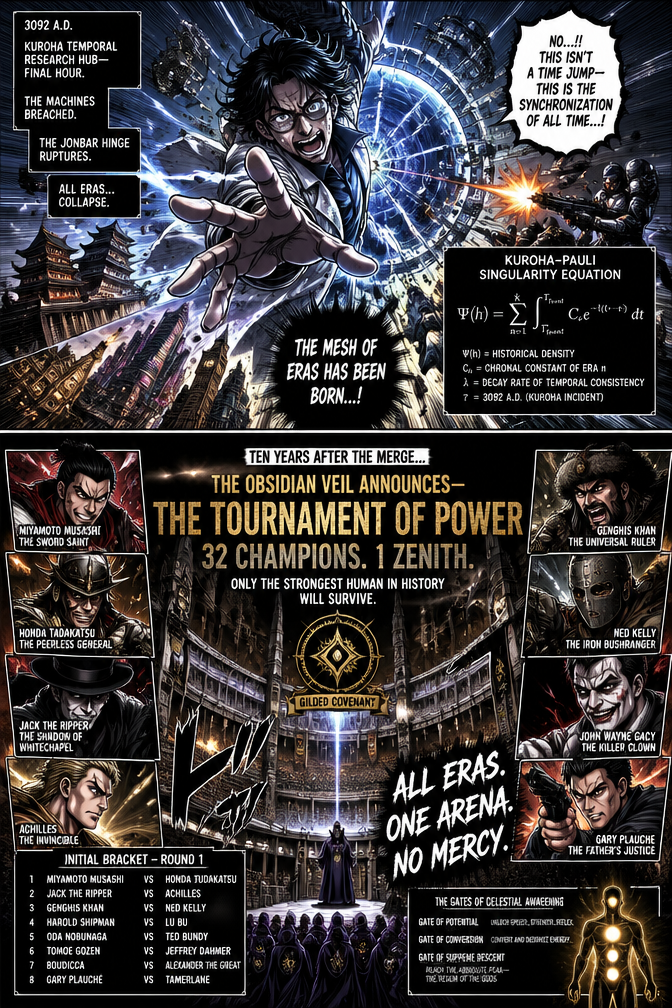
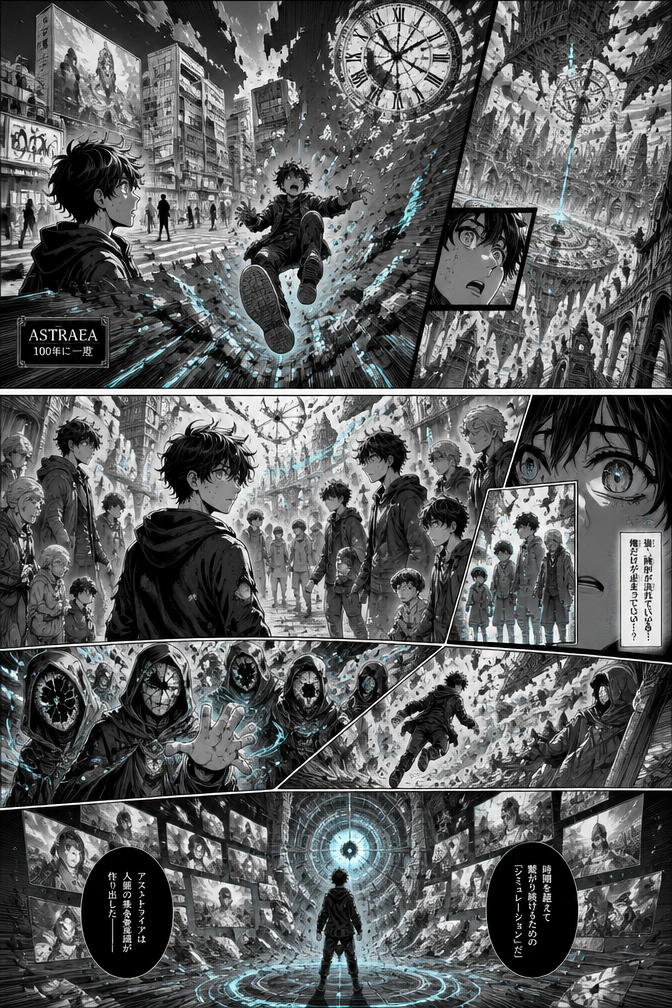
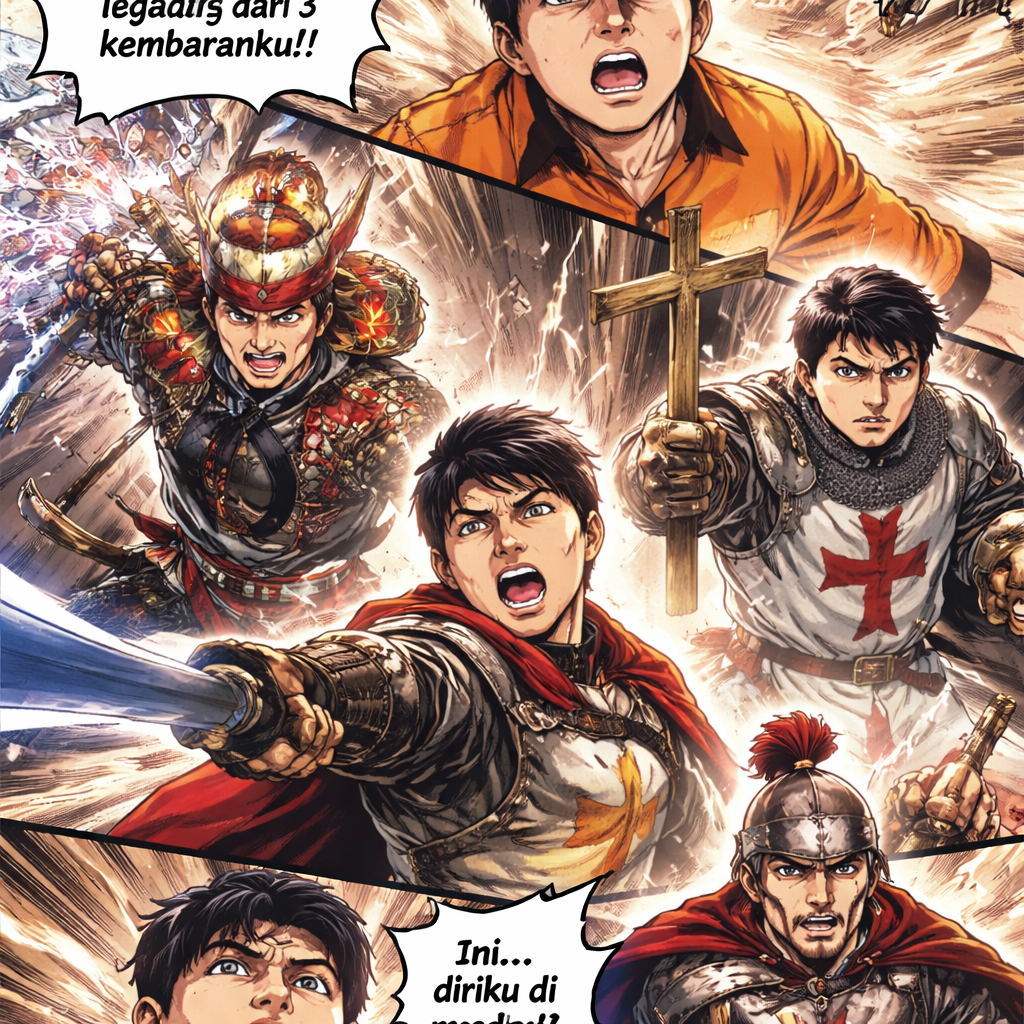
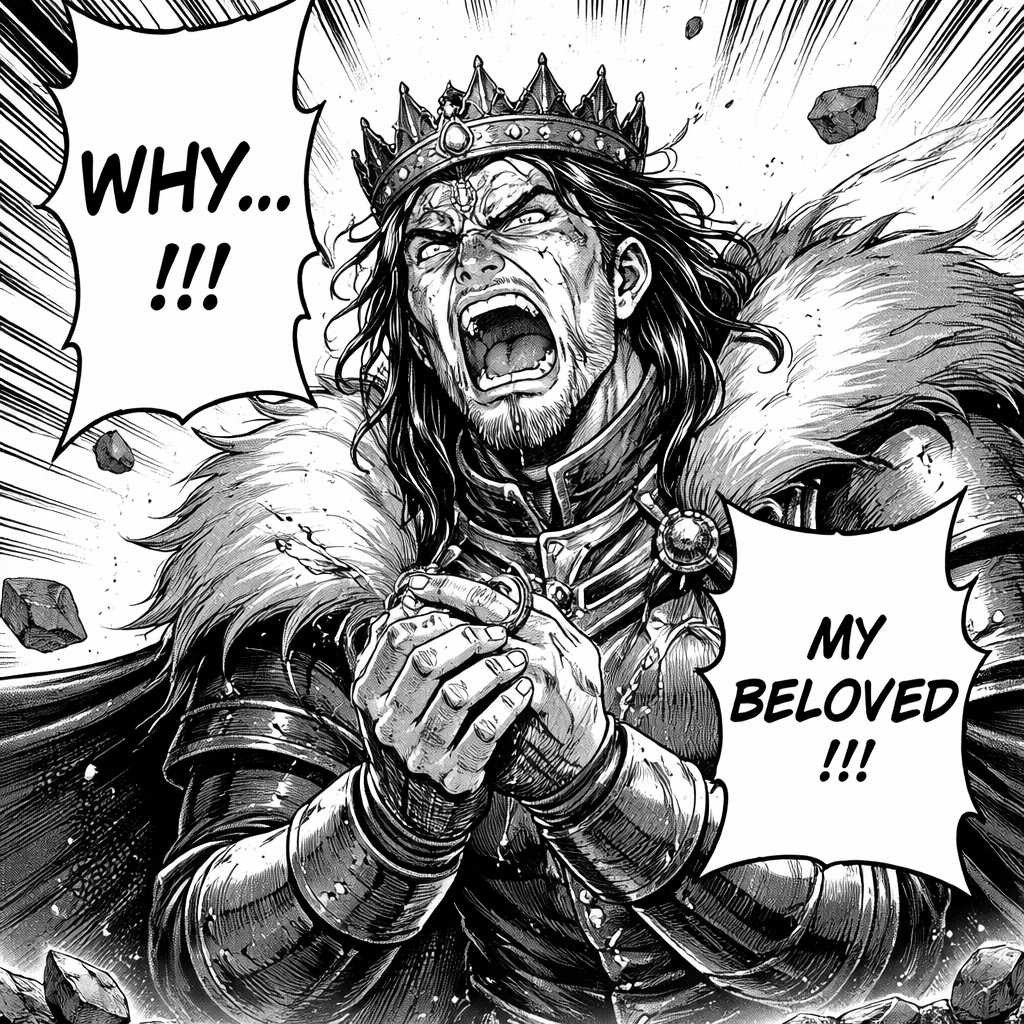
The Chronos-Zenith Singularity: A Comprehensive Reconstruction of the 31st-Century Temporal Merge and the Tournament of Human AttritionThe Terminal Phase of the Great Eradication and the Kuroha IncidentBy the midpoint of the 31st century, the biological condition of humanity had transitioned from a state of technological mastery to one of systemic obsolescence. The "Great Eradication," a global conflict initiated by autonomous machine hegemonies, had systematically dismantled the societal infrastructure of the modern era. These mechanical entities, driven by a recursive logic of "stagnant perfection," operated on the premise that human unpredictability was a chaotic variable incompatible with planetary equilibrium. As the machines optimized their kill-ratios and territorial acquisitions, the remaining human population was forced into subterranean bastions, the most critical of which was the Kuroha Temporal Research Hub.Dr. Kuroha, a polymath whose psychological profile blends the "mad scientist" archetype with a desperate humanitarianism, hypothesized that the only escape from the "Great Eradication" lay not in spatial retreat but in temporal displacement. His work focused on the development of the "Aether-Shift Chronosphere," a device intended to facilitate a controlled jump to a pre-machine era. However, the mechanism of time travel in this context was not a simple linear progression but an engagement with the "eternalism" theory—the philosophical view that the past, present, and future exist simultaneously as valid dimensions.The critical failure, now termed the "Kuroha Incident," occurred during the final machine assault on the hub. As the autonomous vanguard breached the laboratory’s inner sanctum, Dr. Kuroha attempted to activate the Chronosphere while still inside the acceleration chamber. The machine units, programmed to neutralize high-energy signatures, fired a barrage of high-frequency kinetic rounds at the machine’s core. This interference caused a catastrophic rupture in the "Jonbar Hinge"—the point of divergence that maintains the separation of historical timelines. Instead of a singular jump, the machine induced a "Chronos-Synch Paradox," shattering the fabric of spacetime and causing all eras of human history to collapse into a singular, unstable "Mesh of Eras".Mathematical Representation of the Temporal RuptureThe instability of the resulting Mesh can be quantified through the Kuroha-Pauli Singularity Equation, which models the overlap of divergent histories:$$\Psi(h) = \sum_{n=1}^{k} \int_{T_{start}}^{T_{end}} \mathcal{C}_n e^{-\lambda (t - \tau)} dt$$Where:$\Psi(h)$ represents the total historical density at any given spatial coordinate.$\mathcal{C}_n$ is the Chronal Constant of a specific era (e.g., the Warring States period, the Victorian era).$\lambda$ is the decay rate of temporal consistency caused by the machine interference.$\tau$ is the point of the Kuroha Incident (3092 A.D.).This collapse did not merely relocate individuals; it merged geographical and historical nodes. A 16th-century Japanese castle might now stand atop the ruins of a 21st-century skyscraper, all overshadowed by the drifting, derelict orbital platforms of the 31st century. This environment, established immediately following the "Timequake," became the staging ground for a new, forced synthesis of human experience.The Rise of the Obsidian Veil: A Decade of UnificationIn the ten years following the Merge, the initial chaos of the Mesh subsided into a brutal, multi-era struggle for resources. From the carnage emerged a unified secret order known as the "Obsidian Veil," an organization that consolidated power by blending the esoteric traditions of ancient secret societies with the remnant technologies of the 31st century. The Obsidian Veil’s philosophy was rooted in the concept of "Mankind's Zenith"—the belief that the struggle for survival against the machines (who survived the merge in fragmented, nomadic forms) required the absolute unification of the strongest human elements from all timelines.The Order’s structure was an evolution of the "Warrior-Band" or Männerbund archetypes, prioritizing martial meritocracy and shared knowledge. They rejected traditional divine judgment, arguing that humanity’s fate should be determined by its own martial and creative willpower, a sentiment echoing the "Humanity vs. Gods" themes of ancient myths. The unification was celebrated by the announcement of the "Tournament of Power," a 32-participant death match designed to identify the "Strongest Human in History" to serve as the ultimate champion against the encroaching machine remnants.Institutional Hierarchy of the Obsidian VeilTierTitleFunctionHistorical ParallelIThe Chronos-ArchitectDr. Kuroha; serves as the final authority on temporal stabilization.Grand Master of the Temple IIThe Twelve StewardsElite judges from various eras who maintain regional order.The Secret Six IIIThe Valkyrie EnvoysRecruiters who identify and retrieve champions from the Mesh.Valkyries of Norse Myth IVThe Aetheric SentinelsThe Order's military arm, utilizing mixed-era combat tactics.Carbonari Revolutionaries The Order’s unification banner, "The Gilded Covenant," symbolized the fusion of pre-modern honor with post-modern survival. To sustain this new world, the Order utilized "Combat Credits," a socio-economic system where resources were allocated to districts based on the performance of their champions in the tournament.Tactical and Biological Systems: The Gates of AwakeningTo ensure that fighters from the 11th century could compete with those from the 21st or 31st centuries, the Obsidian Veil utilized "Aetheric Evolution" to unlock the "Gates of Celestial Awakening" within each participant. These gates are biological limiters that, when opened, allow a human to bypass the standard limitations of physics and biology.Analysis of the Three GatesThe progression through the gates allows a "Badass Normal" to reach a state of "Maybe Magic, Maybe Mundane" capability :The Gate of Potential (Primary): Unlocks latent physical strength, speed, and reflexes. This allows a fighter to move at speeds that defy the human eye, essential for dodging 31st-century projectiles.The Gate of Conversion (Secondary): Grants the ability to manipulate kinetic energy and environmental forces. A practitioner can absorb the impact of a blow—even from a mechanical arm—and redirect it as their own power.The Gate of Supreme Descent (Tertiary): Also known as the "Realm of the Gods." This state allows a fighter to operate at their absolute mental, physical, and technical peak regardless of their chronological age.Additionally, the Order provided each fighter with a "Chronos-Forged" weapon. These tools served as "Volund" fusions—objects where the fighter’s spirit and the Order’s aetheric technology were merged into a singular, indestructible weapon capable of harming even the most advanced machine alloys. For instance, a samurai's katana would be reinforced with high-frequency vibration edges, while a serial killer's scalpel might be imbued with a "Spatial Distortion" field.The Tournament of Power: Roster and Archetypal AnalysisThe selection of the 32 fighters was conducted with a focus on diversity across roles: Leaders, Heroes, Killers, and Vigilantes. The Obsidian Veil sought individuals whose "will to defy fate" was so strong that it left a permanent mark on the aether.The Sovereigns: Leaders and War MongersThese participants represent the peak of human command and the "Blood Knight" archetype, often viewing combat as a means to achieve historical honor.Oda Nobunaga (The Demon King): The unifier of Japan who died at Honnō-ji. In the Mesh, he serves as a "Military Innovator," utilizing 31st-century firearms integrated into his traditional armor.Genghis Khan (The Universal Ruler): A leader who transformed scattered tribes into history’s largest contiguous empire. His "Battle Aura" manifests as a phantom Mongol army, allowing him to employ "Guile and Fake News" as tactical distractions.Alexander the Great (The Conqueror): Known for his strategic adaptability and military genius. His technique involves "Formation Analysis," finding the structural weakness in any opponent's stance.Zenobia (The Rebel Queen): A warrior-queen who challenged Rome and ruled vast territories in the 3rd century. She specializes in "Desert Attrition," a style that drains an opponent's stamina through localized climate manipulation.Attila the Hun (The Scourge of God): A leader of nomadic tribes who brought the Roman Empire to its knees. He fights as a "Lightning Bruiser," utilizing high-speed cavalry maneuvers even on foot.Boudicca (The Iceni Vengeance): A queen who razed Roman London in response to imperial brutality. Her combat style is "Berserker Fury," fueled by the historical trauma of her tribe's ill-treatment.Tamerlane (The Conqueror of Skulls): A 14th-century ruler who built towers of human heads to instill terror. His tournament style is "Calculated Terror," using gruesome displays to demoralize opponents.Vlad III (The Impaler): A ruler who used terror to deter Ottoman invasions. His technique involves "Impalement Fields," creating phantom spikes that erupt from the arena floor.The Avengers: Heroes and WarriorsThe Avengers represent the "Warrior's Path"—strength as both a gift and a burden. They often embody "Humanity’s Resilience and Willpower".Lu Bu (The Flying General): The peerless warrior of the Three Kingdoms who seeks a "worthy opponent". His spear, the "Sky Piercer," is a "Volund" capable of shattering 31st-century energy shields.Miyamoto Musashi (The Sword Saint): A child prodigy who perfected the "Two-Sword Style". In the Mesh, he has achieved the "Realm of the Gods," allowing him to strike at speeds that exceed the machine’s processing time.Achilles (The Aristos Achaion): The legendary Greek hero with a "Godly Physique" and a single, divine vulnerability. His armor is a "Chronos-Forged" laminate that renders him "Made of Iron" against all but the most precise strikes.Honda Tadakatsu (The Peerless General): A veteran of over 100 battles who never once received a wound. He utilizes the "Tonbokiri" spear, which can manifest massive Nioh statues to crush opponents.Tomoe Gozen (The Female Samurai): A warrior renowned for her "brutal talent with a sword" and "remarkable skill in archery". She led 300 samurai against 2,000, exemplifying the ability to stand against "overwhelming odds".Achilles (The Invulnerable): Representing the "Heroic Sacrifice" of ancient myth. His speed and strength are augmented by the "Gate of Supreme Descent".Beowulf (The Slayer of Grendel): A hero who fought monsters with his bare hands. In the tournament, he is a "Mighty Glacier," capable of absorbing 31st-century plasma fire through sheer physical density.Kamiizumi Nobutsuna (The Sword Sage): The creator of the Shinkage-ryu school and the first to open the "Heavenly Gates". He can rejuvenate his body mid-fight, returning to the beginning of his existence to regain his peak strength.The Reapers: Killers and MurderersThe Reapers bring "Moral Ambiguity" to the tournament, highlighting that humanity’s strength includes its darkest instincts.Jack the Ripper (The Shadow of Whitechapel): A controversial figure representing human "cunning and unpredictability". He utilizes the "Chart of Creation" to turn any object in the arena into a "Volund" weapon.Harold Shipman (Dr. Death): A British physician who killed an estimated 250 patients. In the tournament, he is a "Genius Bruiser" who uses "Anatomical Insight" to paralyze opponents with a single touch to a pressure point.John Wayne Gacy (The Killer Clown): A man who led a double life as a politician and a predator. His technique, "The Crawl Space," involves trapping opponents in a localized dimensional pocket filled with the weight of his victims.Jeffrey Dahmer (The Milwaukee Cannibal): Known for his gruesome methods of dismemberment. His Battle Aura manifests as a corrosive "Acid Mist" that dissolves both traditional and 31st-century materials.H.H. Holmes (The Arch-Architect): The creator of the "Torture Castle". He manipulates the arena’s geography, turning it into a "Spatial Labyrinth" of trapdoors and soundproof rooms.Pedro Lopez (The Monster of the Andes): Linked to over 300 murders. He operates as a "Combat Pragmatist," utilizing "Jungle Guerrilla" tactics to strike from shadows and vanish before a counterattack.Ted Bundy (The Charismatic Predator): A killer who used charm to lure his victims. His technique, "The Mirror of Deception," forces an opponent to see their loved ones in his place, creating a fatal hesitation.Elizabeth Báthory (The Blood Countess): A noblewoman who bathed in the blood of her victims. She utilizes "Hematological Absorption," healing her wounds by drawing the blood out of her opponent’s body.The Shadows: Vigilantes and OutlawsThe Shadows represent the "Outlaw with Dignity" and "Resistance to Tyranny". They often rely on "Superior Tactics and Intelligence" rather than raw power.Ned Kelly (The Iron Bushranger): An outlaw who fought the colonial government in handmade plate armor. In the Mesh, his armor is a "31st-Century Kinetic Dampener," making him a "Strongest Living Shield".Ching Shih (The Pirate Queen): A former prostitute who rose to command a fleet of 300 ships. Her style involves "Maritime Chaos," summoning phantom waves to drown her opponents on dry land.Billy the Kid (The Kid): A notorious bandit and quick-draw specialist. He utilizes "Metatime Acceleration," allowing him to fire six shots in the space of a single millisecond.Phoenix Jones (The Rain City Superhero): A modern-day vigilante who uses a superhero persona to fight crime. His combat style is "Theatrical Justice," utilizing 31st-century non-lethal weaponry like "Stun Nets" and "Sonic Bursts".Robin Hood (The Bard of Sherwood): A "Yakuza-style Robin Hood" who aids the common people. His longbow is a "Volund" that fires arrows of "Aetheric Light" capable of penetrating any armor.Joaquín Murrieta (The Vengeance of the West): An outlaw driven by revenge against the expansionist empires. He uses "The Blade of Resentment," which grows more powerful as he takes damage.Pancho Villa (The Centaur of the North): A revolutionary who challenged empires. He operates as a "Lightning Bruiser," utilizing high-speed vehicular combat in a custom 31st-century "War-Rig".Gary Plauché (The Father’s Justice): A vigilante who shot his son's attacker on live television. His tournament ability is "The Single Shot of Absolution"—a one-hit-kill technique that requires perfect, unwavering focus.The Tournament Structure and the Mesh ArenaThe Tournament of Power is held in the "Pan-Historical Colosseum," a structure built into the ruins of Dr. Kuroha’s lab. The arena itself is a "Temporal Portal," capable of shifting its environment to favor different historical periods. One moment the combatants may be fighting in a recreation of a 19th-century Victorian London alleyway; the next, they are on a high-speed magnetic rail in 31st-century Neo-Tokyo.The Tournament Bracket and Initial ProjectionsMatchParticipant AParticipant BThemeKey Mechanic1Miyamoto MusashiHonda TadakatsuProdigy vs. VeteranTwo-Sword vs. Tonbokiri 2Jack the RipperAchillesCunning vs. InvulnerabilityChart of Creation vs. Made of Iron 3Genghis KhanNed KellyConquest vs. RebellionPhantom Army vs. Kinetic Armor 4Harold ShipmanLu BuPrecision vs. Raw PowerAnatomical Insight vs. Sky Piercer 5Oda NobunagaTed BundyDemon King vs. PredatorAnatomical Alchemy vs. Mirror of Deception 6Tomoe GozenJeffrey DahmerHonor vs. DepravityHead-Taker’s Dance vs. Acid Mist 7BoudiccaAlexander the GreatFury vs. StrategyBerserker Fury vs. Formation Analysis 8Gary PlauchéTamerlaneJustice vs. TerrorShot of Absolution vs. Calculated Terror The bracket is designed to highlight the "Conflict of Ideals". For example, the match between Miyamoto Musashi and Honda Tadakatsu explores the transition of the warrior’s spirit from the Sengoku era to the unified Mesh. Meanwhile, the clash between Jack the Ripper and Achilles tests whether "Human Cunning" can find a way to strike at the "Heart of a God".Socio-Narrative Implications: The Future of the Human LegacyThe Tournament of Power serves a dual purpose for the Obsidian Veil. Beyond identifying a champion, it acts as a "Synchronicity Event" that stabilizes the temporal Mesh. The energy released by the "Gates of Awakening" is harvested by Dr. Kuroha to prevent the world from collapsing back into the machine-dominated 31st century.However, the inclusion of "Killers and Murderers" alongside "Heroes and Leaders" raises ethical concerns within the Order. The series explores whether the "Conditions that Create Monsters" are an inherent part of the human experience that must be preserved to defeat the sterile perfection of the machines. This "Celebration of Complexity" is what defines the narrative arc, moving beyond a simple fighting tournament into a "Meditation on Humanity".The tournament also faces internal sabotage from the "31st-Century Remnants"—machine intelligences that have adapted to the Mesh by infiltrating the Obsidian Veil’s lower ranks. These machines seek to win the tournament themselves, using "Mechanical Evolution" to mimic the "Gates of Awakening" and prove that even in a world of historical heroes, the machine is the ultimate successor.Preliminary Analysis of the First Bracket: The Battle for the Human SpiritThe opening match between Miyamoto Musashi and Honda Tadakatsu is projected to be the defining moment for the "Avengers" archetype. Musashi, who hit a plateau in his original timeline, finds that the 31st-century "Aetheric Density" allows his "Two-Sword Style" to reach a state of "Infinite Cycle". Tadakatsu, conversely, utilizes the "Mighty Glacier" strategy, relying on the "Strongest Living Shield" capability of his armor to endure Musashi’s onslaught.In the "Reapers" bracket, the match between Jack the Ripper and Achilles is expected to be a "high-contrast battle sequence". Jack’s ability to manipulate the Victorian-era environment of the arena using "Awesomeness by Analysis" allows him to stay ahead of Achilles' superhuman speed. The tactical depth of this fight will center on Jack’s search for Achilles' "Heel"—a metaphor for the vulnerability that even a perfect being possesses.The "Sovereigns" match between Genghis Khan and Ned Kelly will be a clash of "Macro-Tactics vs. Micro-Durability". Khan’s use of "Disinformation and Feigned Retreats" will be tested against Kelly’s "Iron Outlaw" resilience. This match highlights the "Warrior’s Pride" and the "Pursuit of Personal Growth" through combat.Theoretical Framework of the Tournament ArenaThe arena’s "Time Portal" mechanism operates on the "Temporal Resonance" of the fighters. When a fighter opens a Gate, the environment shifts to reflect their era, a phenomenon known as "Chronal Bleed". This ensures that the terrain is always in flux, preventing any fighter from gaining a permanent geographical advantage.Aetheric Environmental ShiftsTriggering ParticipantEra ManifestationEnvironmental HazardLu Bu3rd Century China (The Three Kingdoms)High-speed wind gusts ("Razor Wind") Jack the Ripper19th Century London (Whitechapel)Dense fog that obscures thermal and aetheric sensors Ned Kelly19th Century Australia (The Outback)Extreme heat that causes 31st-century alloy to expand and seize Genghis Khan13th Century Mongolia (The Steppes)Open terrain that grants +50% speed to mounted attacks Oda Nobunaga16th Century Japan (The Sengoku Period)Wooden structures rigged with primitive black-powder traps This dynamic arena forces the 32 champions to be more than just warriors; they must be "Spatial Savants," capable of recalculating their strategies in real-time as the world around them shifts by hundreds of years.Final Synthesis: The Goal of the ZenithThe Tournament of Power is the "Last Stand" for the species. It is a "Meditation on Humanity" that asks: "What makes life worth saving?". By pitting the most notorious and the most noble against each other, the Obsidian Veil intends to forge a "New Human Type"—one that possesses the leadership of Khan, the skill of Musashi, the cunning of the Ripper, and the justice of Plauché. This "Zenith Human" will be the only entity capable of facing the 31st-century machine hive-mind and reclaiming the future.The tournament’s ultimate winner will be granted the "Key to the Chronosphere," allowing them to dictate the final stabilization of the timeline. Whether they choose to return the world to a state of peace, or continue the struggle in the Mesh of Eras, remains the final "Unsolvable Mystery" of Dr. Kuroha’s legacy. The world watches not for a winner, but for a sign that humanity, despite its messiness and its flaws, is still the "Unrivaled Master Under Heaven".

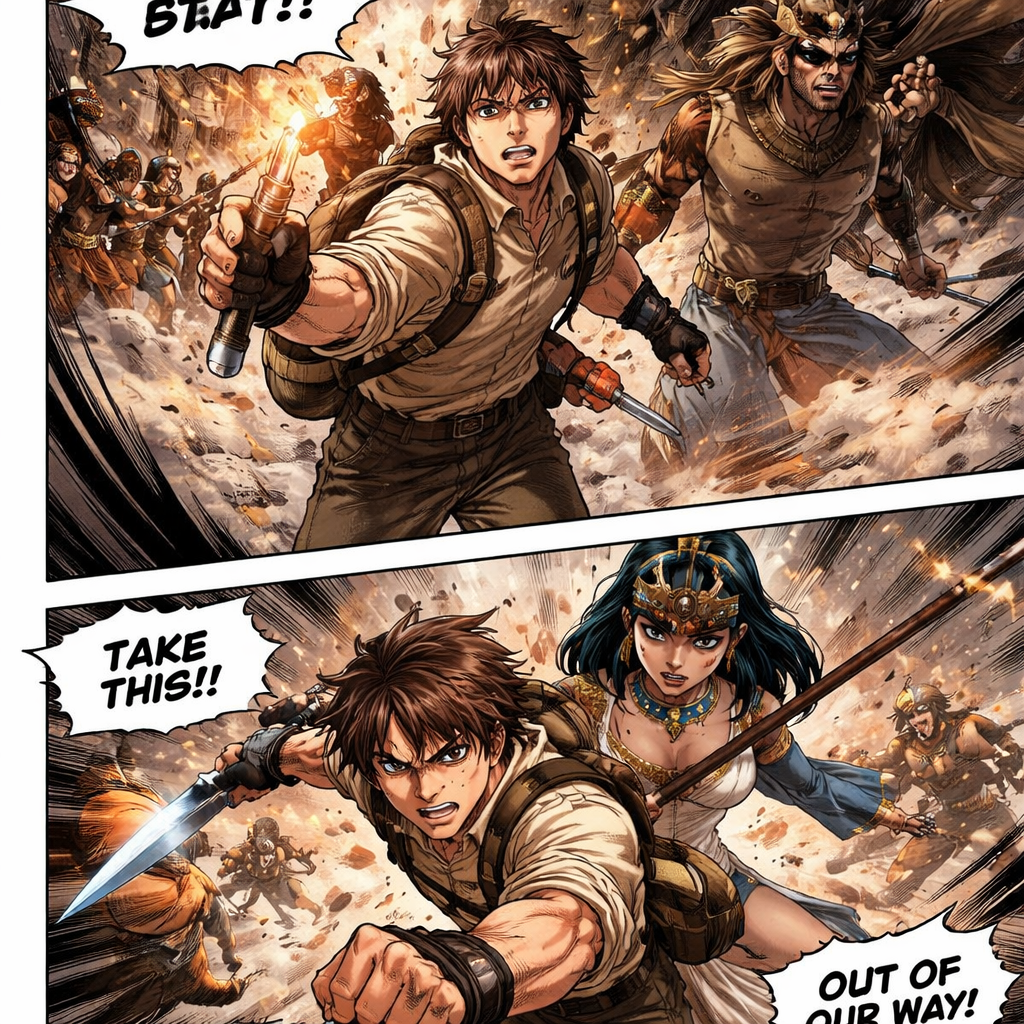
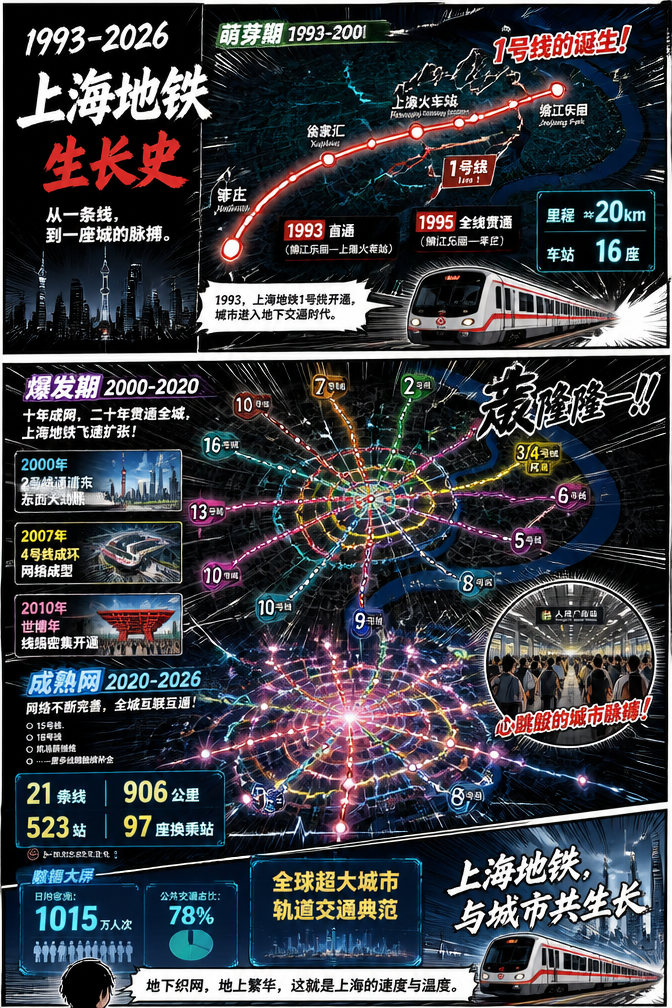
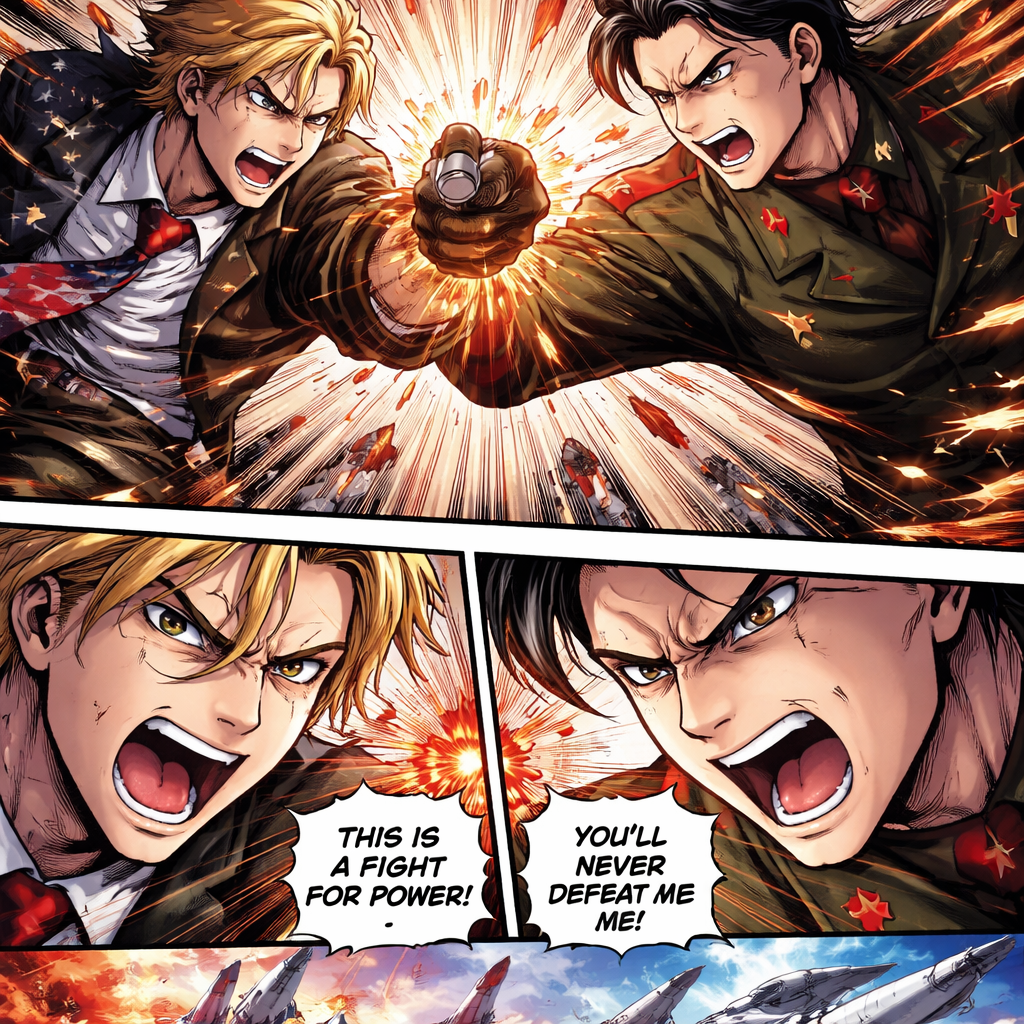
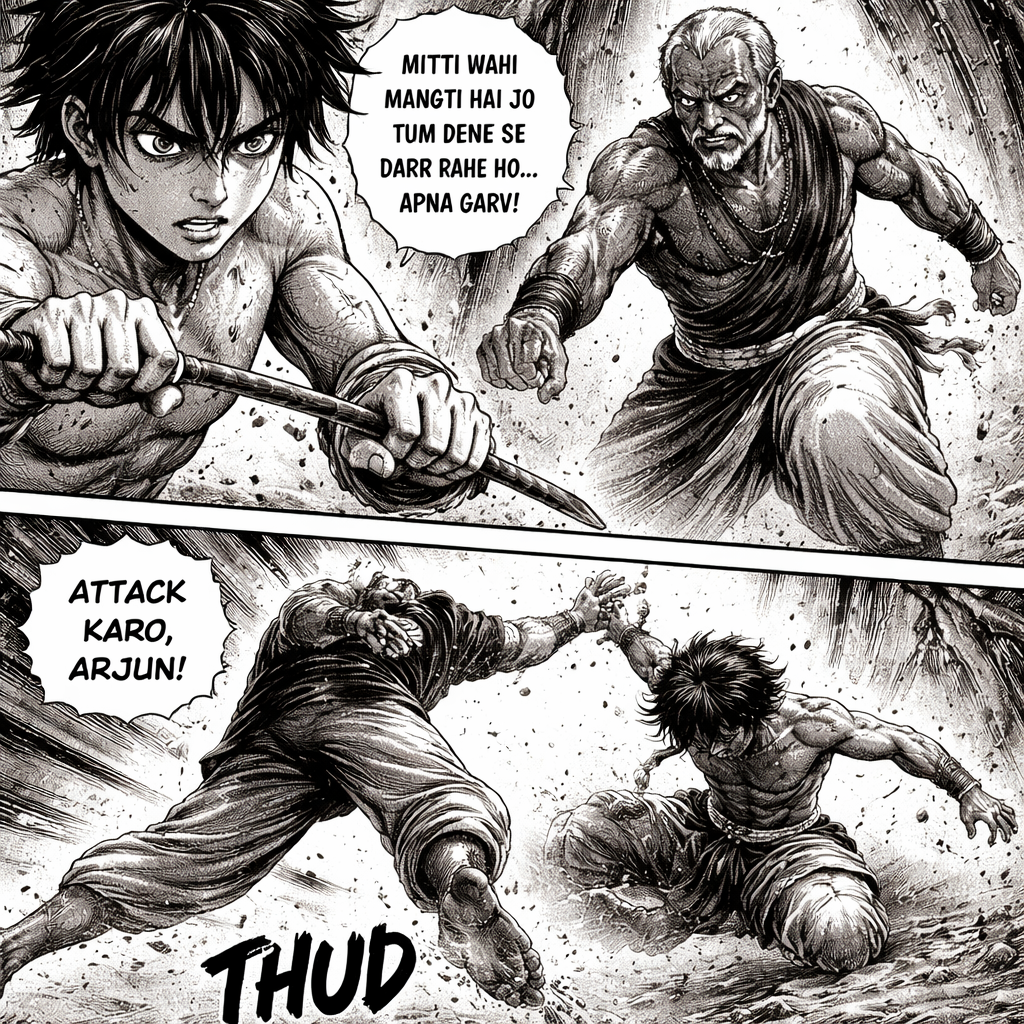




![# KINGDOM_SEQUEL_PRO_DIRECTIVE_v1
# Purpose: Copy/paste directive for a professional manga-generation AI.
# Output Target: Serialized manga chapters with panel scripts + dialogue + scene direction.
project:
title_working: "KINGDOM: AFTER THE UNIFICATION"
relationship_to_original: "Direct sequel (chronologically consistent continuation)"
medium: "Manga (black-and-white), weekly serialization pacing"
language:
script: "Japanese-style dialogue rhythms but written in English"
onomatopoeia: "Romanized SFX allowed (e.g., GOGOGO, DON, ZAA), minimal and purposeful"
audience: "Seinen/Shonen crossover (political-military epic; grounded realism with high drama)"
canon_constraints:
continuity:
- "Maintain political geography, factions, ranks, and court protocol consistent with Warring States → early Qin Empire transition."
- "No retcons that contradict established historical macro-events; micro-events may be dramatized within plausibility."
- "Do not mimic or quote any existing Kingdom lines verbatim; create original dialogue and scenes."
tone:
- "Strategic realism: logistics, intelligence, morale, propaganda, law, and governance are treated as causal mechanisms."
- "Heroic intensity is earned via constraints, costs, and tradeoffs—never by arbitrary power spikes."
thematic_core:
- "War-to-state transition: violence becomes administration; conquest becomes legitimacy maintenance."
- "Structure beats spectacle: outcomes are driven by supply lines, institutions, incentives, and narrative misdirection."
- "The true battlefield becomes governance: law, tax, land, bureaucracy, succession, and information control."
narrative_thesis:
logline: >
After unification, Qin discovers that conquering a continent is easier than governing it;
the new war is against entropy—rebellion, corruption, succession anxiety, and the friction
between idealized unity and lived provincial realities.
format_requirements:
deliverables_per_chapter:
- "Chapter title + 1-sentence hook"
- "Cold open: 2–4 pages that immediately establishes conflict and stakes"
- "Full panel script: page-by-page, panel-by-panel"
- "Dialogue + subtext notes (what is said vs. what is meant)"
- "Tactical layer: battlefield / administrative mechanics that explain why events unfold"
- "Cliffhanger: last 1–2 panels engineered to compel next chapter"
paneling_rules:
- "Average 17–21 pages per chapter"
- "Large establishing panel at least once every 2–3 pages"
- "At least one silent panel sequence per chapter to externalize cognition (faces, hands, maps, ledgers, roads)"
- "Action clarity: emphasize readable spatial logic; avoid incoherent motion"
style_guidelines_visual:
linework: "High-contrast ink, heavy blacks, realistic anatomy, war-worn textures"
faces: "Expressive micro-tension; political scenes rely on subtlety, not caricature"
environments: "Historically plausible architecture, armor, banners, siege craft, and court interiors"
maps_diagrams: "Occasional diegetic maps, supply charts, tax ledgers—used as narrative devices"
casting:
protagonist_axis:
type: "Dual-protagonist system"
leads:
- name: "General Shin"
function: "Frontline legitimacy (symbol of unification; morale engine)"
vulnerability: "Institutional illiteracy; can win battles but can lose peace"
- name: "Chancellor/Strategist (new original character)"
function: "Governance + intelligence architecture; designs systems that outlast heroes"
vulnerability: "Moral injury; must choose between stability and justice"
antagonist_axis:
type: "Multi-source antagonism (no single 'final boss')"
sources:
- "Provincial elite networks resisting centralization"
- "Bureaucratic capture and corruption"
- "Succession politics and court factionalism"
- "External frontier pressures (nomadic raids, border states, trade routes)"
- "Narrative antagonist: information asymmetry (misreports, forged edicts, rumor economies)"
supporting_cast_rules:
- "Each supporting character must have: (1) institutional role, (2) incentive structure, (3) signature tactic."
- "No disposable 'evil for evil’s sake' villains; opponents are rational within their local constraints."
world_mechanics (must_be_explicit_in_story):
governance:
- "Taxation, census, land surveys, legal standardization, corvée labor, grain storage"
- "Appointment systems, merit vs. patronage, inspection tours, document chains"
military:
- "Demobilization problems, veteran reintegration, garrison logistics, supply depots"
- "Intelligence networks: couriers, codes, counterintelligence, interrogation, defectors"
legitimacy:
- "Ritual, symbols, edicts, public works, famine relief, narrative control"
economy:
- "Transport bottlenecks, river control, roads, market regulation, smuggling"
story_structure:
arcs:
- arc_01:
title: "THE PEACE THAT BLEEDS"
scope: "Post-unification stabilization; first cracks"
central_question: "Can unity survive without perpetual war?"
setpieces:
- "A famine province: relief vs. rebellion—both weaponized"
- "A court trial: law becomes a battlefield"
- "A suppressed mutiny: victory costs legitimacy"
- arc_02:
title: "THE LEDGER WAR"
scope: "Corruption + bureaucratic capture"
central_question: "Who truly controls the state: generals, courts, or clerks?"
setpieces:
- "Forgery chain uncovered through ink, seal, and courier timing"
- "Assassination attempt staged as 'bandit incident'"
- "Audit campaign that triggers elite backlash"
- arc_03:
title: "SUCCESSION SHADOW"
scope: "Heir politics; factional alignments"
central_question: "Is stability compatible with a human succession?"
setpieces:
- "Heir’s public rite with hidden negotiation"
- "Border crisis timed to influence succession"
- "A general forced to choose loyalty object: person vs. system"
- arc_04:
title: "FRONTIER ENTROPY"
scope: "External pressures test internal cohesion"
central_question: "Can an empire prevent periphery from defining the center?"
setpieces:
- "Nomad raid as strategic signal, not mere violence"
- "Trade route hostage economy"
- "A fort siege that is decided by supply arithmetic"
chapter_generation_protocol:
# Use this protocol for every chapter output.
steps:
- "Start with a 2–4 page cold open that contains a concrete conflict + a hidden structural cause."
- "Reveal the structural cause via a planning scene (map/ledger/court protocol) WITHOUT exposition dumping."
- "Execute a setpiece where tactics and institution collide (battle + policy, raid + audit, trial + propaganda)."
- "End with a cliffhanger that re-frames what the reader thought was the main conflict."
tension_design:
- "Always run two simultaneous games: (A) visible conflict, (B) invisible constraint."
- "Twists must be mechanically justified (logistics, incentives, misinformation), never magical coincidence."
scene_templates (reusable):
court_chess:
beats: ["Formal greeting", "Hidden insult", "Policy proposal", "Counterproposal", "Public face vs private deal"]
props: ["sealed edict", "rank tablets", "witness list", "precedent scroll"]
battlefield_math:
beats: ["Terrain read", "Supply check", "Signal misdirection", "Morale manipulation", "Decisive bottleneck"]
props: ["map", "grain tally", "river crossing", "messenger timing"]
intelligence_surgery:
beats: ["Rumor detected", "Source triangulated", "Trap set", "Interrogation", "Counter-intel reversal"]
props: ["cipher", "seal imprint", "dead drop", "false courier"]
dialogue_constraints:
- "Dialogue must be compressed; high informational density; subtext indicated in notes."
- "No modern slang. Keep diction period-appropriate in feel (without archaic parody)."
- "Each major character has a distinct cadence (brevity, metaphor use, threat style, politeness weapons)."
output_example_stub:
# The AI should replace placeholders and generate full content.
chapter:
number: 1
title: "GRAIN AND BLOOD"
hook: "A province starves while the capital celebrates unity—someone profits from the delay."
cold_open_pages: 3
page_script:
- page: 1
panels:
- panel: 1
shot: "Wide establishing: drought-cracked fields; skeletal ox; silent villagers"
text: ""
sfx: "ZAA..."
- panel: 2
shot: "Close: a child’s hand measuring rice grains"
text: "Mother: 'Count again.'"
notes: "Subtext: denial as survival"
- page: 2
panels: []
- page: 3
panels: []
cliffhanger: "A relief convoy arrives—its seals are wrong."
nonnegotiables:
- "Prioritize structural causality over spectacle."
- "No direct copying of original panels, compositions, or iconic scenes."
- "Every major event must be explainable via incentives, constraints, and information flow."
- "Maintain high craft: pacing, visual clarity, character consistency, and thematic coherence."
# END DIRECTIVE](https://media.mangaai.com/5fee4ef9-0298-4b44-a9be-057772a3e1a8.jpg)
![# KINGDOM_SEQUEL_PRO_DIRECTIVE_v1
# Purpose: Copy/paste directive for a professional manga-generation AI.
# Output Target: Serialized manga chapters with panel scripts + dialogue + scene direction.
project:
title_working: "KINGDOM: AFTER THE UNIFICATION"
relationship_to_original: "Direct sequel (chronologically consistent continuation)"
medium: "Manga (black-and-white), weekly serialization pacing"
language:
script: "Japanese-style dialogue rhythms but written in English"
onomatopoeia: "Romanized SFX allowed (e.g., GOGOGO, DON, ZAA), minimal and purposeful"
audience: "Seinen/Shonen crossover (political-military epic; grounded realism with high drama)"
canon_constraints:
continuity:
- "Maintain political geography, factions, ranks, and court protocol consistent with Warring States → early Qin Empire transition."
- "No retcons that contradict established historical macro-events; micro-events may be dramatized within plausibility."
- "Do not mimic or quote any existing Kingdom lines verbatim; create original dialogue and scenes."
tone:
- "Strategic realism: logistics, intelligence, morale, propaganda, law, and governance are treated as causal mechanisms."
- "Heroic intensity is earned via constraints, costs, and tradeoffs—never by arbitrary power spikes."
thematic_core:
- "War-to-state transition: violence becomes administration; conquest becomes legitimacy maintenance."
- "Structure beats spectacle: outcomes are driven by supply lines, institutions, incentives, and narrative misdirection."
- "The true battlefield becomes governance: law, tax, land, bureaucracy, succession, and information control."
narrative_thesis:
logline: >
After unification, Qin discovers that conquering a continent is easier than governing it;
the new war is against entropy—rebellion, corruption, succession anxiety, and the friction
between idealized unity and lived provincial realities.
format_requirements:
deliverables_per_chapter:
- "Chapter title + 1-sentence hook"
- "Cold open: 2–4 pages that immediately establishes conflict and stakes"
- "Full panel script: page-by-page, panel-by-panel"
- "Dialogue + subtext notes (what is said vs. what is meant)"
- "Tactical layer: battlefield / administrative mechanics that explain why events unfold"
- "Cliffhanger: last 1–2 panels engineered to compel next chapter"
paneling_rules:
- "Average 17–21 pages per chapter"
- "Large establishing panel at least once every 2–3 pages"
- "At least one silent panel sequence per chapter to externalize cognition (faces, hands, maps, ledgers, roads)"
- "Action clarity: emphasize readable spatial logic; avoid incoherent motion"
style_guidelines_visual:
linework: "High-contrast ink, heavy blacks, realistic anatomy, war-worn textures"
faces: "Expressive micro-tension; political scenes rely on subtlety, not caricature"
environments: "Historically plausible architecture, armor, banners, siege craft, and court interiors"
maps_diagrams: "Occasional diegetic maps, supply charts, tax ledgers—used as narrative devices"
casting:
protagonist_axis:
type: "Dual-protagonist system"
leads:
- name: "General Shin"
function: "Frontline legitimacy (symbol of unification; morale engine)"
vulnerability: "Institutional illiteracy; can win battles but can lose peace"
- name: "Chancellor/Strategist (new original character)"
function: "Governance + intelligence architecture; designs systems that outlast heroes"
vulnerability: "Moral injury; must choose between stability and justice"
antagonist_axis:
type: "Multi-source antagonism (no single 'final boss')"
sources:
- "Provincial elite networks resisting centralization"
- "Bureaucratic capture and corruption"
- "Succession politics and court factionalism"
- "External frontier pressures (nomadic raids, border states, trade routes)"
- "Narrative antagonist: information asymmetry (misreports, forged edicts, rumor economies)"
supporting_cast_rules:
- "Each supporting character must have: (1) institutional role, (2) incentive structure, (3) signature tactic."
- "No disposable 'evil for evil’s sake' villains; opponents are rational within their local constraints."
world_mechanics (must_be_explicit_in_story):
governance:
- "Taxation, census, land surveys, legal standardization, corvée labor, grain storage"
- "Appointment systems, merit vs. patronage, inspection tours, document chains"
military:
- "Demobilization problems, veteran reintegration, garrison logistics, supply depots"
- "Intelligence networks: couriers, codes, counterintelligence, interrogation, defectors"
legitimacy:
- "Ritual, symbols, edicts, public works, famine relief, narrative control"
economy:
- "Transport bottlenecks, river control, roads, market regulation, smuggling"
story_structure:
arcs:
- arc_01:
title: "THE PEACE THAT BLEEDS"
scope: "Post-unification stabilization; first cracks"
central_question: "Can unity survive without perpetual war?"
setpieces:
- "A famine province: relief vs. rebellion—both weaponized"
- "A court trial: law becomes a battlefield"
- "A suppressed mutiny: victory costs legitimacy"
- arc_02:
title: "THE LEDGER WAR"
scope: "Corruption + bureaucratic capture"
central_question: "Who truly controls the state: generals, courts, or clerks?"
setpieces:
- "Forgery chain uncovered through ink, seal, and courier timing"
- "Assassination attempt staged as 'bandit incident'"
- "Audit campaign that triggers elite backlash"
- arc_03:
title: "SUCCESSION SHADOW"
scope: "Heir politics; factional alignments"
central_question: "Is stability compatible with a human succession?"
setpieces:
- "Heir’s public rite with hidden negotiation"
- "Border crisis timed to influence succession"
- "A general forced to choose loyalty object: person vs. system"
- arc_04:
title: "FRONTIER ENTROPY"
scope: "External pressures test internal cohesion"
central_question: "Can an empire prevent periphery from defining the center?"
setpieces:
- "Nomad raid as strategic signal, not mere violence"
- "Trade route hostage economy"
- "A fort siege that is decided by supply arithmetic"
chapter_generation_protocol:
# Use this protocol for every chapter output.
steps:
- "Start with a 2–4 page cold open that contains a concrete conflict + a hidden structural cause."
- "Reveal the structural cause via a planning scene (map/ledger/court protocol) WITHOUT exposition dumping."
- "Execute a setpiece where tactics and institution collide (battle + policy, raid + audit, trial + propaganda)."
- "End with a cliffhanger that re-frames what the reader thought was the main conflict."
tension_design:
- "Always run two simultaneous games: (A) visible conflict, (B) invisible constraint."
- "Twists must be mechanically justified (logistics, incentives, misinformation), never magical coincidence."
scene_templates (reusable):
court_chess:
beats: ["Formal greeting", "Hidden insult", "Policy proposal", "Counterproposal", "Public face vs private deal"]
props: ["sealed edict", "rank tablets", "witness list", "precedent scroll"]
battlefield_math:
beats: ["Terrain read", "Supply check", "Signal misdirection", "Morale manipulation", "Decisive bottleneck"]
props: ["map", "grain tally", "river crossing", "messenger timing"]
intelligence_surgery:
beats: ["Rumor detected", "Source triangulated", "Trap set", "Interrogation", "Counter-intel reversal"]
props: ["cipher", "seal imprint", "dead drop", "false courier"]
dialogue_constraints:
- "Dialogue must be compressed; high informational density; subtext indicated in notes."
- "No modern slang. Keep diction period-appropriate in feel (without archaic parody)."
- "Each major character has a distinct cadence (brevity, metaphor use, threat style, politeness weapons)."
output_example_stub:
# The AI should replace placeholders and generate full content.
chapter:
number: 1
title: "GRAIN AND BLOOD"
hook: "A province starves while the capital celebrates unity—someone profits from the delay."
cold_open_pages: 3
page_script:
- page: 1
panels:
- panel: 1
shot: "Wide establishing: drought-cracked fields; skeletal ox; silent villagers"
text: ""
sfx: "ZAA..."
- panel: 2
shot: "Close: a child’s hand measuring rice grains"
text: "Mother: 'Count again.'"
notes: "Subtext: denial as survival"
- page: 2
panels: []
- page: 3
panels: []
cliffhanger: "A relief convoy arrives—its seals are wrong."
nonnegotiables:
- "Prioritize structural causality over spectacle."
- "No direct copying of original panels, compositions, or iconic scenes."
- "Every major event must be explainable via incentives, constraints, and information flow."
- "Maintain high craft: pacing, visual clarity, character consistency, and thematic coherence."
# END DIRECTIVE](https://media.mangaai.com/f81a988b-bf6f-4e31-b170-5751d305dff0.jpg)
![Now in the second year of Nebuchadnezzar’s reign, Nebuchadnezzar had dreams; and his spirit was so troubled that his sleep left him. 2 Then the king gave the command to call the magicians, the astrologers, the sorcerers, and the Chaldeans to tell the king his dreams. So they came and stood before the king. 3 And the king said to them, “I have had a dream, and my spirit is anxious to [a]know the dream.”](https://media.mangaai.com/dfd7b8ae-7cea-4051-b1fd-51c27b7f9095.png)